Ch 10: Dynamics of Rotational Motion
Young & Freedman Calc - University Physics 14th Edition
Young & Freedman Calc14th EditionUniversity PhysicsISBN: 9780321973610Not the one you use?Change textbook
Chapter 10, Problem 34e

An airplane propeller is 2.08 m in length (from tip to tip) and has a mass of 117 kg. When the airplane's engine is first started, it applies a constant torque of 1950 Nm to the propeller, which starts from rest. What is the instantaneous power output of the motor at the instant that the propeller has turned through 5.00 revolutions?

Verified step by step guidance
1
First, convert the number of revolutions into radians. Since one revolution is \(2\pi\) radians, multiply 5.00 revolutions by \(2\pi\) to get the angular displacement in radians.
Next, use the work-energy principle. The work done by the torque is equal to the change in rotational kinetic energy. The work done \(W\) is given by \(W = \tau \theta\), where \(\tau\) is the torque and \(\theta\) is the angular displacement in radians.
Calculate the angular velocity \(\omega\) at the point when the propeller has turned through the given angular displacement. Use the equation \(\omega^2 = \omega_0^2 + 2\alpha\theta\), where \(\omega_0\) is the initial angular velocity (0 rad/s since it starts from rest), \(\alpha\) is the angular acceleration, and \(\theta\) is the angular displacement.
Determine the angular acceleration \(\alpha\) using the relation \(\tau = I\alpha\), where \(I\) is the moment of inertia of the propeller. For a rod rotating about its center, \(I = \frac{1}{12}mL^2\), where \(m\) is the mass and \(L\) is the length of the propeller.
Finally, calculate the instantaneous power output \(P\) of the motor using the formula \(P = \tau \omega\), where \(\tau\) is the torque and \(\omega\) is the angular velocity at the given instant.

Verified video answer for a similar problem:

This video solution was recommended by our tutors as helpful for the problem above.
Video duration:
5m
Was this helpful?

Key Concepts

Here are the essential concepts you must grasp in order to answer the question correctly.

Torque

Torque is a measure of the rotational force applied to an object, causing it to rotate around an axis. It is calculated as the product of force and the distance from the axis of rotation, and is measured in Newton-meters (N•m). In this problem, the engine applies a constant torque to the propeller, initiating its rotation.
Recommended video:
Guided course
08:55
Net Torque & Sign of Torque

Angular Displacement

Angular displacement refers to the angle through which an object rotates around a fixed axis, measured in radians or revolutions. In this scenario, the propeller turns through 5.00 revolutions, which is crucial for calculating the angular velocity and subsequently the power output of the motor.
Recommended video:
Guided course
14:03
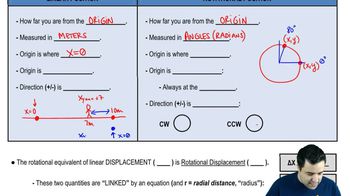
Rotational Position & Displacement

Power in Rotational Motion

Power in rotational motion is the rate at which work is done or energy is transferred in a rotating system. It is calculated as the product of torque and angular velocity. Understanding this concept is essential for determining the instantaneous power output of the motor when the propeller has completed 5.00 revolutions.
Recommended video:
Guided course
07:18
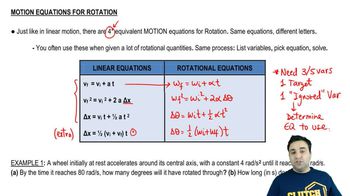
Equations of Rotational Motion