Ch 10: Dynamics of Rotational Motion
Young & Freedman Calc - University Physics 14th Edition
Young & Freedman Calc14th EditionUniversity PhysicsISBN: 9780321973610Not the one you use?Change textbook
Chapter 10, Problem 35b

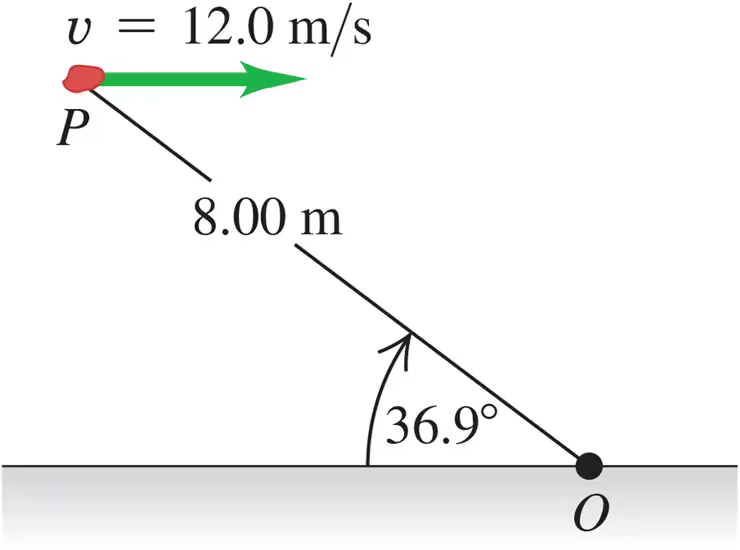
A 2.00-kg rock has a horizontal velocity of magnitude 12.0 m/s when it is at point P in Fig. E10.35. If the only force acting on the rock is its weight, what is the rate of change (magnitude and direction) of its angular momentum at this instant?

Verified step by step guidance
1
Identify the given values: mass of the rock (m = 2.00 kg), horizontal velocity (v = 12.0 m/s), distance from point O to point P (r = 8.00 m), and angle between the position vector and the horizontal (θ = 36.9°).
Understand that the rate of change of angular momentum is given by the torque acting on the rock. Torque (τ) is calculated using the formula τ = r × F, where F is the force acting perpendicular to the position vector.
Since the only force acting on the rock is its weight, calculate the gravitational force: F = m × g, where g is the acceleration due to gravity (approximately 9.81 m/s²).
Determine the component of the gravitational force that is perpendicular to the position vector. This is given by F_perpendicular = F × sin(θ).
Calculate the torque using τ = r × F_perpendicular. The direction of the torque will be perpendicular to the plane formed by the position vector and the force vector, following the right-hand rule.

Verified video answer for a similar problem:

This video solution was recommended by our tutors as helpful for the problem above.
Video duration:
8m
Was this helpful?

Key Concepts

Here are the essential concepts you must grasp in order to answer the question correctly.

Angular Momentum

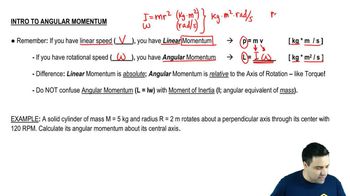
Angular momentum is a measure of the rotational motion of an object and is given by the product of the object's moment of inertia and its angular velocity. For a point mass, it can be calculated as the cross product of the position vector and linear momentum. It is a vector quantity, indicating both magnitude and direction, and is conserved in a closed system without external torques.
Recommended video:
Guided course
06:18
Intro to Angular Momentum

Torque

Torque is the rotational equivalent of force and is defined as the cross product of the lever arm distance and the force applied. It causes changes in the rotational motion of an object. The rate of change of angular momentum is directly proportional to the net external torque acting on the system, as described by the equation τ = dL/dt, where τ is torque and L is angular momentum.
Recommended video:
Guided course
08:55
Net Torque & Sign of Torque

Conservation of Angular Momentum

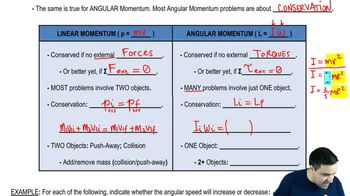
The conservation of angular momentum states that if no external torque acts on a system, the total angular momentum of the system remains constant. This principle is crucial in analyzing systems where rotational motion is involved, such as the motion of planets or the behavior of spinning objects. In the given problem, since the only force acting is gravity, which acts through the center of mass, there is no external torque, and angular momentum is conserved.
Recommended video:
Guided course
12:12
Conservation of Angular Momentum
Related Practice
Textbook Question

Compute the torque developed by an industrial motor whose output is 150 kW at an angular speed of 4000 rev/min.

Textbook Question

A 2.00-kg rock has a horizontal velocity of magnitude 12.0 m/s when it is at point P in Fig. E10.35. At this instant, what are the magnitude and direction of its angular momentum relative to point O?

2
views
Textbook Question

A woman with mass 50 kg is standing on the rim of a large disk that is rotating at 0.80 rev/s about an axis through its center. The disk has mass 110 kg and radius 4.0 m. Calculate the magnitude of the total angular momentum of the woman–disk system. (Assume that you can treat the woman as a point.)

1
views
Textbook Question

An airplane propeller is 2.08 m in length (from tip to tip) and has a mass of 117 kg. When the airplane's engine is first started, it applies a constant torque of 1950 Nm to the propeller, which starts from rest. What is the instantaneous power output of the motor at the instant that the propeller has turned through 5.00 revolutions?

Textbook Question

Calculate the magnitude of the angular momentum of the earth in a circular orbit around the sun. Is it reasonable to model it as a particle? Consult Appendix E and the astronomical data in Appendix F

3
views
Textbook Question

A hollow, thin-walled sphere of mass 12.0kg12.0\(\operatorname{kg}\) and diameter 48.0 cm48.0\(\text{ cm}\) is rotating about an axle through its center. The angle (in radians) through which it turns as a function of time (in seconds) is given by θ(t)=At2+Bt4θ(t) = At^2 + Bt^4, where A has numerical value 1.501.50 and B has numerical value 1.101.10. What are the units of the constants A and B?

1
views