
A Carnot refrigerator is operated between two heat reservoirs at temperatures of K and K. If in each cycle the refrigerator receives J of heat energy from the reservoir at K, how many joules of heat energy does it deliver to the reservoir at K?
A Carnot heat engine uses a hot reservoir consisting of a large amount of boiling water and a cold reservoir consisting of a large tub of ice and water. In minutes of operation, the heat rejected by the engine melts kg of ice. During this time, how much work is performed by the engine?
Verified step by step guidance
Verified video answer for a similar problem:
Key Concepts
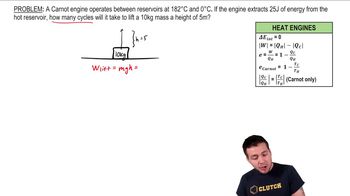
Carnot Heat Engine
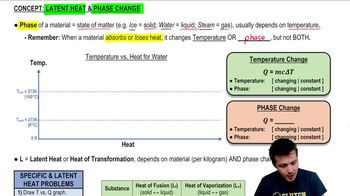
Latent Heat of Fusion
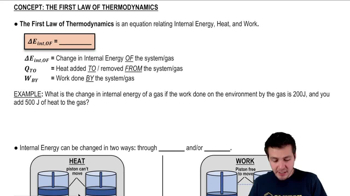
First Law of Thermodynamics
A sophomore with nothing better to do adds heat to kg of ice at °C until it is all melted. What is the change in entropy of the water?
A Carnot refrigerator is operated between two heat reservoirs at temperatures of K and K. What is the coefficient of performance of the refrigerator?
You decide to take a nice hot bath but discover that your thoughtless roommate has used up most of the hot water. You fill the tub with kg of °C water and attempt to warm it further by pouring in kg of boiling water from the stove. Is this a reversible or an irreversible process? Use physical reasoning to explain.
A Carnot refrigerator is operated between two heat reservoirs at temperatures of K and K. If the refrigerator completes cycles each minute, what power input is required to operate it?
A -kg block of ice at °C falls into the ocean and melts. The average temperature of the ocean is °C, including all the deep water. By how much does the change of this ice to water at °C alter the entropy of the world? Does the entropy increase or decrease? (Hint: Do you think that the ocean temperature will change appreciably as the ice melts?)
