Ch 20: The Second Law of Thermodynamics
Young & Freedman Calc - University Physics 14th Edition
Young & Freedman Calc14th EditionUniversity PhysicsISBN: 9780321973610Not the one you use?Change textbook
Chapter 20, Problem 21a

A sophomore with nothing better to do adds heat to 0.3500.350 kg of ice at 0.00.0°C until it is all melted. What is the change in entropy of the water?

Verified step by step guidance
1
Identify the process: The problem involves melting ice at 0°C, which is a phase change from solid to liquid. During this process, the temperature remains constant while the ice absorbs heat.
Calculate the heat absorbed (Q) during the melting process: Use the formula Q = m * L_f, where m is the mass of the ice (0.350 kg) and L_f is the latent heat of fusion for ice (approximately 334,000 J/kg).
Understand the concept of entropy change (ΔS): Entropy is a measure of disorder or randomness. For a reversible process at constant temperature, the change in entropy can be calculated using the formula ΔS = Q / T, where Q is the heat absorbed and T is the absolute temperature in Kelvin.
Convert the temperature from Celsius to Kelvin: Since the process occurs at 0.0°C, convert this to Kelvin by adding 273.15, resulting in T = 273.15 K.
Calculate the change in entropy (ΔS): Substitute the values of Q and T into the formula ΔS = Q / T to find the change in entropy of the water as the ice melts.

Verified video answer for a similar problem:

This video solution was recommended by our tutors as helpful for the problem above.
Video duration:
1m
Was this helpful?

Key Concepts

Here are the essential concepts you must grasp in order to answer the question correctly.

Entropy

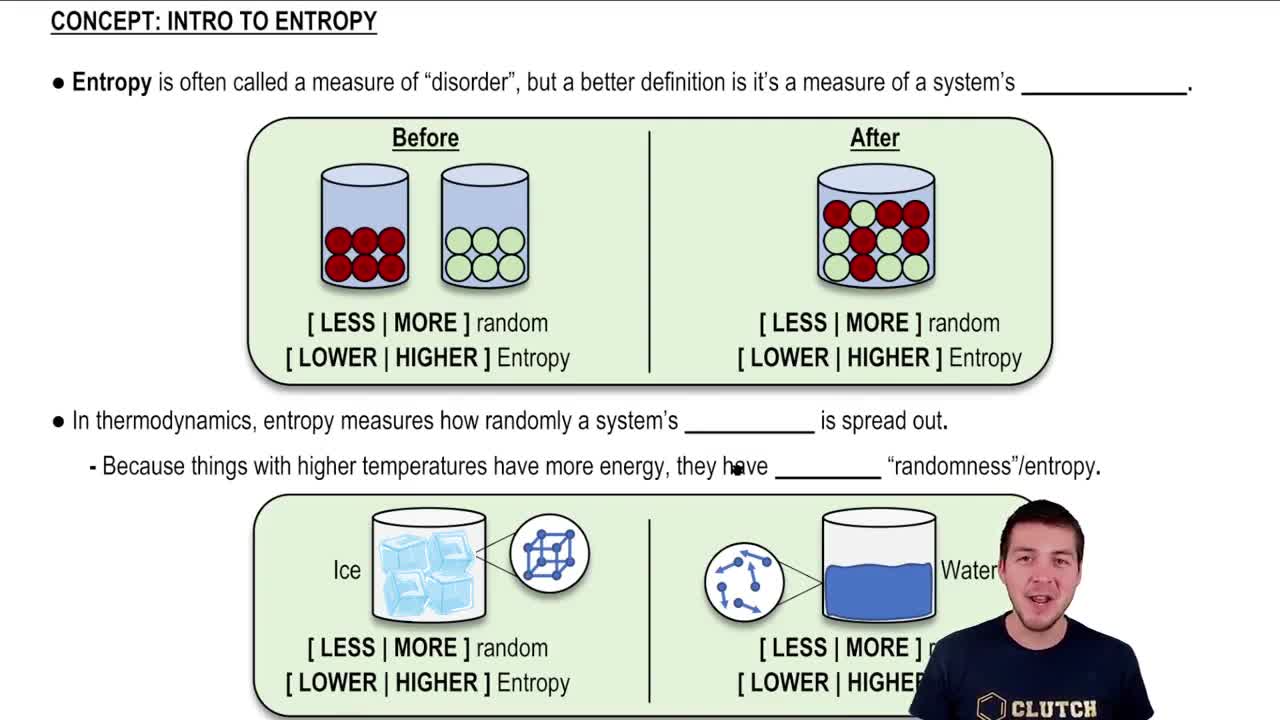
Entropy is a measure of the disorder or randomness in a system. In thermodynamics, it quantifies the amount of energy in a physical system that is not available to do work. When heat is added to a system, such as melting ice, the entropy increases because the molecules become more disordered as they transition from a solid to a liquid state.
Recommended video:
Guided course
07:50
Intro to Entropy

Latent Heat of Fusion

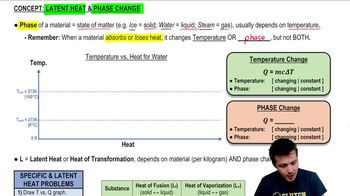
The latent heat of fusion is the amount of heat required to change a unit mass of a solid into a liquid without a change in temperature. For ice, this is approximately 334,000 J/kg. This concept is crucial for calculating the heat added to melt the ice, which is necessary to determine the change in entropy.
Recommended video:
Guided course
10:40
Latent Heat & Phase Changes

Thermodynamic Process

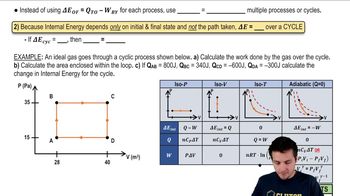
A thermodynamic process involves the transfer of heat and work into or out of a system, leading to changes in its state. In this scenario, the process is isothermal, meaning the temperature remains constant at 0°C while the ice melts. Understanding this helps in applying the formula for entropy change, ΔS = Q/T, where Q is the heat added and T is the absolute temperature.
Recommended video:
Guided course
08:45
Properties of Cyclic Thermodynamic Processes
Related Practice
Textbook Question

A Carnot refrigerator is operated between two heat reservoirs at temperatures of 320320 K and 270270 K. What is the coefficient of performance of the refrigerator?

2
views

Textbook Question

You decide to take a nice hot bath but discover that your thoughtless roommate has used up most of the hot water. You fill the tub with 195195 kg of 30.030.0°C water and attempt to warm it further by pouring in 5.005.00 kg of boiling water from the stove. Is this a reversible or an irreversible process? Use physical reasoning to explain.

1
views
Textbook Question

You make tea with 0.2500.250 kg of 85.085.0°C water and let it cool to room temperature (20.020.0°C). Calculate the entropy change of the water while it cools.

1
views
Textbook Question

A 15.015.0-kg block of ice at 0.00.0°C melts to liquid water at 0.00.0°C inside a large room at 20.020.0°C. Treat the ice and the room as an isolated system, and assume that the room is large enough for its temperature change to be ignored. Is the melting of the ice reversible or irreversible? Explain, using simple physical reasoning without resorting to any equations.

1
views
Textbook Question

A Carnot heat engine uses a hot reservoir consisting of a large amount of boiling water and a cold reservoir consisting of a large tub of ice and water. In 55 minutes of operation, the heat rejected by the engine melts 0.04000.0400 kg of ice. During this time, how much work WW is performed by the engine?

2
views
Textbook Question

A 4.504.50-kg block of ice at 0.000.00°C falls into the ocean and melts. The average temperature of the ocean is 3.503.50°C, including all the deep water. By how much does the change of this ice to water at 3.503.50°C alter the entropy of the world? Does the entropy increase or decrease? (Hint: Do you think that the ocean temperature will change appreciably as the ice melts?)

1
views