Ch. 13 - Fluids
Giancoli Douglas - Physics for Scientists and Engineers 5th edition
Giancoli Douglas5th editionPhysics for Scientists and EngineersISBN: 9780137488179Not the one you use?Change textbook
Chapter 13, Problem 6a

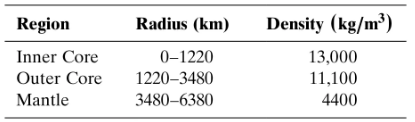
The Earth is not a uniform sphere, but has regions of varying density. Consider a simple model of the Earth divided into three regions—inner core, outer core, and mantle. Let us assume each region has a constant density (the average density of that region in the real Earth). Use this model to predict the average density of the entire Earth.
Table displaying Earth's regions with their respective radius and density values: Inner Core, Outer Core, and Mantle.

Verified step by step guidance
1
Identify the given data: The Earth is divided into three regions—inner core, outer core, and mantle. Each region has a constant density. Let the densities of the inner core, outer core, and mantle be denoted as \( \rho_1 \), \( \rho_2 \), and \( \rho_3 \), respectively. Let their respective volumes be \( V_1 \), \( V_2 \), and \( V_3 \).
Recall the formula for average density: The average density of the Earth can be calculated using the formula \( \rho_{\text{avg}} = \frac{\text{Total Mass}}{\text{Total Volume}} \). Since mass is the product of density and volume, the total mass can be expressed as \( M = \rho_1 V_1 + \rho_2 V_2 + \rho_3 V_3 \).
Express the total volume: The total volume of the Earth is the sum of the volumes of the three regions, \( V_{\text{total}} = V_1 + V_2 + V_3 \).
Substitute the expressions for total mass and total volume into the formula for average density: \( \rho_{\text{avg}} = \frac{\rho_1 V_1 + \rho_2 V_2 + \rho_3 V_3}{V_1 + V_2 + V_3} \).
To solve the problem, plug in the given or known values for \( \rho_1 \), \( \rho_2 \), \( \rho_3 \), \( V_1 \), \( V_2 \), and \( V_3 \) into the formula. Simplify the expression to calculate the average density of the Earth.

Verified video answer for a similar problem:

This video solution was recommended by our tutors as helpful for the problem above.
Video duration:
12m
Was this helpful?

Key Concepts

Here are the essential concepts you must grasp in order to answer the question correctly.

Density

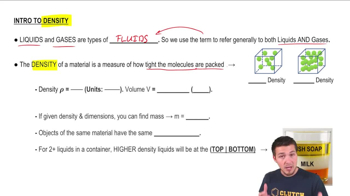
Density is defined as mass per unit volume and is a crucial property of materials. In the context of the Earth, different regions (inner core, outer core, mantle) have distinct densities that contribute to the overall average density of the planet. Understanding how to calculate average density involves knowing the mass and volume of each region and applying the formula for average density accordingly.
Recommended video:
Guided course
8:13
Intro to Density

Volume of Spheres

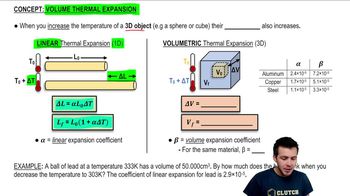
The Earth can be approximated as a series of concentric spherical layers, each with its own density. The volume of a sphere is calculated using the formula V = (4/3)πr³, where r is the radius. For each region of the Earth, knowing the radius allows us to determine the volume, which is essential for calculating the mass of each layer when combined with its density.
Recommended video:
Guided course
05:21
Volume Thermal Expansion

Weighted Average

To find the average density of the Earth using the densities of its layers, a weighted average approach is used. This involves multiplying the density of each layer by its volume to find its contribution to the total mass, then dividing the total mass by the total volume of the Earth. This method ensures that regions with larger volumes have a proportionate influence on the average density calculation.
Recommended video:
Guided course
10:19
Torque Due to Weight