

Ch 19: Work, Heat, and the First Law of Thermodynamics
Knight Calc - Physics for Scientists and Engineers 5th Edition
Knight Calc5th EditionPhysics for Scientists and EngineersISBN: 9780137344796Not the one you use?Change textbook
Chapter 19, Problem 12a

A rapidly spinning paddle wheel raises the temperature of 200 mL of water from 21°C to 25°C. How much heat is transferred?

Verified step by step guidance
1
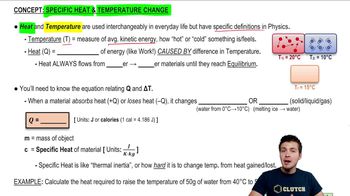
Step 1: Understand the problem. The paddle wheel increases the temperature of water, and we need to calculate the heat transferred. The formula to use is the specific heat equation: Q = mcΔT, where Q is the heat transferred, m is the mass of the water, c is the specific heat capacity of water, and ΔT is the change in temperature.
Step 2: Convert the volume of water (200 mL) to mass. Since the density of water is approximately 1 g/mL, the mass of 200 mL of water is 200 g. Convert this to kilograms for SI units: m = 200 \, \(\text{g}\) = 0.2 \, \(\text{kg}\).
Step 3: Identify the specific heat capacity of water. The specific heat capacity of water is approximately c = 4186 \, \(\text{J/kg°C}\).
Step 4: Calculate the temperature change, ΔT. The initial temperature is 21°C, and the final temperature is 25°C. Therefore, ΔT = 25 - 21 = 4 \, \(\text{°C}\).
Step 5: Substitute the values into the formula Q = mcΔT. Use m = 0.2 \, \(\text{kg}\), c = 4186 \, \(\text{J/kg°C}\), and ΔT = 4 \, \(\text{°C}\). Perform the multiplication to find the heat transferred.

Verified video answer for a similar problem:

This video solution was recommended by our tutors as helpful for the problem above.
Video duration:
2m
Was this helpful?

Key Concepts

Here are the essential concepts you must grasp in order to answer the question correctly.

Specific Heat Capacity

Specific heat capacity is the amount of heat required to raise the temperature of a unit mass of a substance by one degree Celsius. For water, this value is approximately 4.18 J/g°C. Understanding this concept is crucial for calculating the heat transfer in the given scenario, as it allows us to relate the temperature change to the amount of heat absorbed by the water.
Recommended video:
Guided course
06:50
Specific Heat & Temperature Changes

Heat Transfer Equation

The heat transfer equation, often expressed as Q = mcΔT, relates the heat transferred (Q) to the mass (m) of the substance, its specific heat capacity (c), and the change in temperature (ΔT). In this case, ΔT is the difference between the final and initial temperatures of the water. This equation is fundamental for determining how much heat is transferred to the water as it is heated by the paddle wheel.
Recommended video:
Guided course
05:14
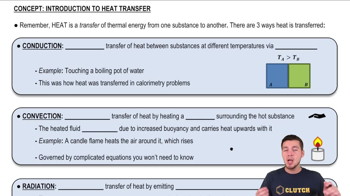
Overview of Heat Transfer

Mass of Water

The mass of water is essential for calculating heat transfer, as it directly influences the total heat absorbed. Since the density of water is approximately 1 g/mL, 200 mL of water has a mass of about 200 grams. Knowing the mass allows us to apply the heat transfer equation accurately, ensuring that we account for the total amount of water being heated in the process.
Recommended video:
Guided course
20:32
Mass Spectrometers