
Ch. 31 - Maxwell's Equations and Electromagnetic Waves
Giancoli Douglas - Physics for Scientists and Engineers 5th edition
Giancoli Douglas5th editionPhysics for Scientists and EngineersISBN: 9780137488179Not the one you use?Change textbook
Chapter 30, Problem 48

A satellite beams microwave radiation with a power of 16 kW toward the Earth’s surface, 550 km away. When the beam strikes Earth, its circular diameter is about 1500 m. Find the rms electric field strength of the beam.

Verified step by step guidance
1
Understand the problem: We are tasked with finding the root mean square (rms) electric field strength of a microwave beam. The given data includes the power of the beam (P = 16 kW), the distance to the Earth's surface (550 km), and the diameter of the beam on Earth's surface (1500 m). The relationship between power, intensity, and the electric field strength will be used.
Step 1: Calculate the intensity of the beam. Intensity (I) is defined as the power (P) per unit area (A). The area of the circular beam can be calculated using the formula for the area of a circle: \( A = \pi r^2 \), where \( r \) is the radius of the beam. Here, \( r = \frac{1500}{2} \) meters. Substitute this into the formula for intensity: \( I = \frac{P}{A} = \frac{P}{\pi r^2} \).
Step 2: Relate the intensity to the rms electric field strength. The intensity of an electromagnetic wave is related to the rms electric field strength (E_rms) by the formula: \( I = \frac{1}{2} c \varepsilon_0 E_{\text{rms}}^2 \), where \( c \) is the speed of light in a vacuum (\( 3 \times 10^8 \ \text{m/s} \)) and \( \varepsilon_0 \) is the permittivity of free space (\( 8.85 \times 10^{-12} \ \text{F/m} \)). Rearrange this formula to solve for \( E_{\text{rms}} \): \( E_{\text{rms}} = \sqrt{\frac{2I}{c \varepsilon_0}} \).
Step 3: Substitute the expression for intensity (\( I = \frac{P}{\pi r^2} \)) into the formula for \( E_{\text{rms}} \). This gives: \( E_{\text{rms}} = \sqrt{\frac{2 \cdot \frac{P}{\pi r^2}}{c \varepsilon_0}} \).
Step 4: Plug in the known values: \( P = 16 \times 10^3 \ \text{W} \), \( r = 750 \ \text{m} \), \( c = 3 \times 10^8 \ \text{m/s} \), and \( \varepsilon_0 = 8.85 \times 10^{-12} \ \text{F/m} \). Simplify the expression to find \( E_{\text{rms}} \).

Verified video answer for a similar problem:

This video solution was recommended by our tutors as helpful for the problem above.
Video duration:
9m
Was this helpful?

Key Concepts

Here are the essential concepts you must grasp in order to answer the question correctly.

Power and Intensity

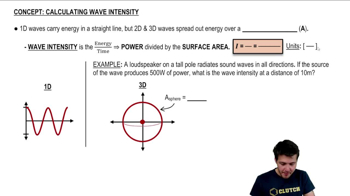
Power is the rate at which energy is transferred or converted, measured in watts (W). Intensity, on the other hand, is the power per unit area, typically expressed in watts per square meter (W/m²). In this context, the intensity of the microwave beam can be calculated by dividing the power of the beam by the area over which it is distributed when it reaches the Earth's surface.
Recommended video:
Guided course
02:32
Wave Intensity

Electric Field Strength

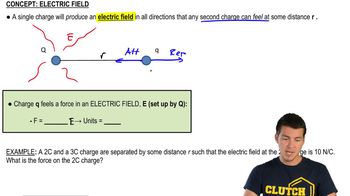
The electric field strength (E) is a measure of the force per unit charge experienced by a charged particle in an electric field. It is related to the intensity of an electromagnetic wave, where the root mean square (rms) electric field strength can be derived from the intensity using the formula E = √(2 * I / ε₀), where I is the intensity and ε₀ is the permittivity of free space.
Recommended video:
Guided course
03:16
Intro to Electric Fields

Area of a Circle

The area of a circle is calculated using the formula A = πr², where r is the radius. In this problem, the diameter of the beam is given, allowing us to find the radius (half of the diameter) and subsequently calculate the area over which the microwave power is distributed. This area is essential for determining the intensity of the beam at the Earth's surface.
Recommended video:
Guided course
04:05
Calculating Work As Area Under F-x Graphs
Related Practice
Textbook Question

Suppose you have a car with a 100-hp engine. How large a solar panel would you need to replace the engine with solar power? Assume that the solar panels can utilize 20% of the maximum solar energy that reaches the Earth’s surface (1000 W/m²). Explain why or why not this is practical.

Textbook Question

A global positioning system (GPS) functions by determining the travel times for EM waves from various satellites to a moving GPS receiver on Earth (car or hiker). If the receiver is to detect a change in the receiver’s position on the order of 3 m, what is the associated change in travel time (in ns) that must be measured?

Textbook Question

Compare 1030 on the AM dial to 103.1 on FM. Which has the longer wavelength, and by what factor is it larger?

Textbook Question

Radio-controlled clocks throughout the United States receive a radio signal from a transmitter in Fort Collins, Colorado, that accurately (within a microsecond) marks the beginning of each minute. A slight amount of time is added by a clock at any location to correct for the signal travel time to the clock from Fort Collins. Assuming Fort Collins is no more than 3000 km from any point in the U.S., what is the longest travel-time delay?

Textbook Question

Who will hear the voice of a singer first: a person in the balcony 50.0 km away from the stage (see Fig. 31–26), or a person 1800 km away at home whose ear is next to the radio listening to a live broadcast? Roughly how much sooner? Assume the microphone is a few centimeters from the singer and the temperature is 20℃.


<IMAGE>

1
views
Textbook Question

An amateur radio operator wishes to build a receiver that can tune a range from 14.0 MHz to 15.0 MHz. A variable capacitor has a minimum capacitance of 95 pF.

(a) What is the required value of the inductance?

(b) What is the maximum capacitance used on the variable capacitor?

2
views