
Consider a hydrogen atom in stationary state n. On average, an atom stays in the n = 2 state for 1.6 ns before undergoing a transition to the n = 1 state. On average, how many revolutions does the electron make before the transition?
Ch 38: Quantization
Knight Calc5th EditionPhysics for Scientists and EngineersISBN: 9780137344796Not the one you use?Change textbook
Chapter 38, Problem 56
The first three energy levels of the fictitious element X were shown in Figure P38.54. An electron with a speed of 1.4×10⁶ m/s collides with an atom of element X. Shortly afterward, the atom emits a photon with a wavelength of 1240 nm. What was the electron’s speed after the collision? Assume that, because the atom is much more massive than the electron, the recoil of the atom is negligible. Hint: The energy of the photon is not the energy transferred to the atom in the collision.
Verified step by step guidance1
Step 1: Calculate the energy of the emitted photon using the formula for photon energy: \( E_{photon} = \frac{hc}{\lambda} \), where \( h \) is Planck's constant \( 6.626 \times 10^{-34} \, \text{J·s} \), \( c \) is the speed of light \( 3.00 \times 10^8 \; \text{m/s} \), and \( \lambda \) is the wavelength of the photon \( 1240 \; \text{nm} \). Convert \( \lambda \) to meters before substituting.
Step 2: Determine the energy difference between the energy levels of the atom that corresponds to the emitted photon. This energy difference is equal to the energy of the photon calculated in Step 1. Use the energy level diagram (Figure P38.54) to identify the initial and final energy levels of the atom.
Step 3: Calculate the initial kinetic energy of the electron before the collision using the formula \( KE_{initial} = \frac{1}{2}mv^2 \), where \( m \) is the mass of the electron \( 9.11 \times 10^{-31} \, \text{kg} \) and \( v \) is the initial speed of the electron \( 1.4 \times 10^6 \; \text{m/s} \).
Step 4: Use the principle of conservation of energy to find the kinetic energy of the electron after the collision. The energy transferred to the atom is the energy difference between its initial and final energy levels (calculated in Step 2). Subtract this energy from the initial kinetic energy of the electron to find its final kinetic energy: \( KE_{final} = KE_{initial} - \Delta E_{atom} \).
Step 5: Solve for the final speed of the electron using the relationship between kinetic energy and speed: \( v_{final} = \sqrt{\frac{2KE_{final}}{m}} \). Substitute the values for \( KE_{final} \) and \( m \) to calculate the final speed of the electron.

Verified video answer for a similar problem:
This video solution was recommended by our tutors as helpful for the problem above.
Was this helpful?
Key Concepts
Here are the essential concepts you must grasp in order to answer the question correctly.
Energy Levels and Photons
In atomic physics, energy levels refer to the specific energies that electrons can have within an atom. When an electron collides with an atom, it can transfer energy, causing the atom to emit a photon. The energy of the emitted photon can be calculated using the formula E = hc/λ, where h is Planck's constant, c is the speed of light, and λ is the wavelength of the photon. This concept is crucial for understanding how energy is exchanged during atomic interactions.
Recommended video:
Guided course
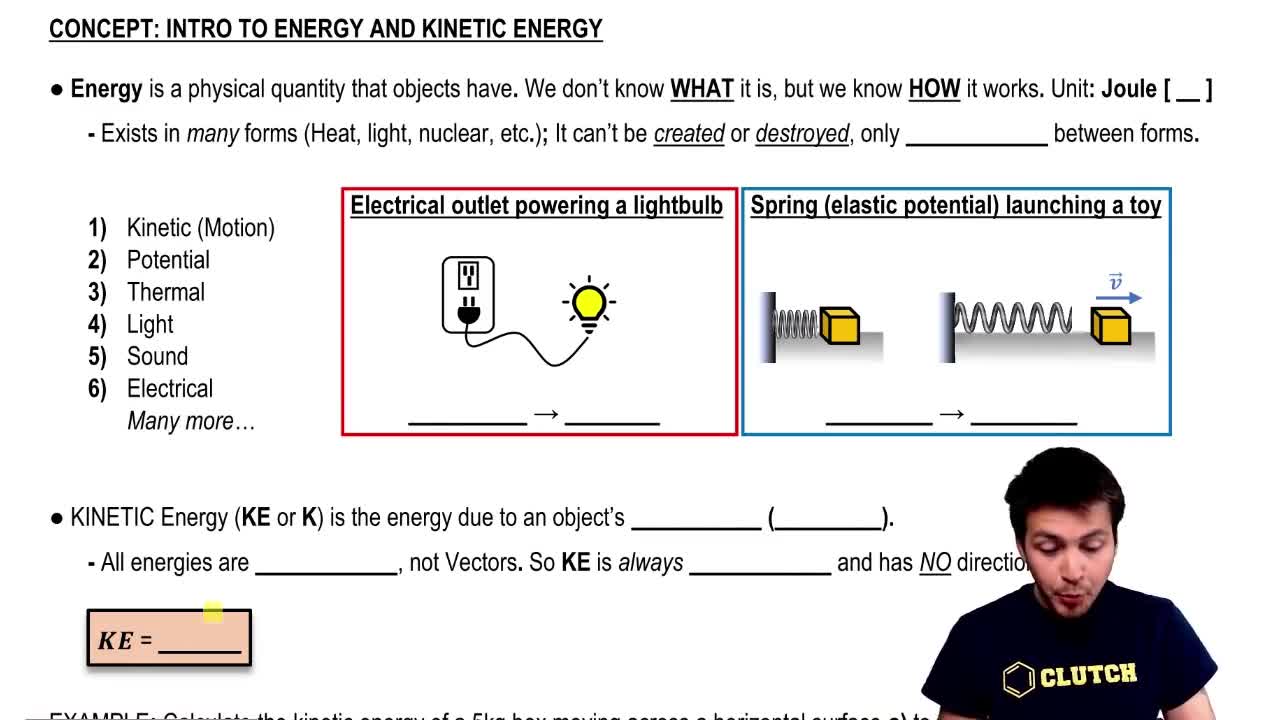
Intro to Energy & Types of Energy
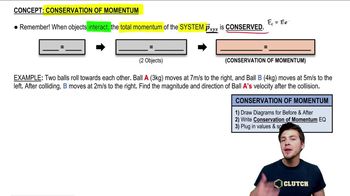
Conservation of Momentum
The principle of conservation of momentum states that the total momentum of a closed system remains constant if no external forces act on it. In the context of the collision between the electron and the atom, the momentum before the collision must equal the momentum after the collision. Since the atom is much more massive than the electron, the change in the atom's velocity is negligible, allowing us to focus on the electron's speed change to solve the problem.
Recommended video:
Guided course
Conservation Of Momentum
Kinetic Energy and Collisions
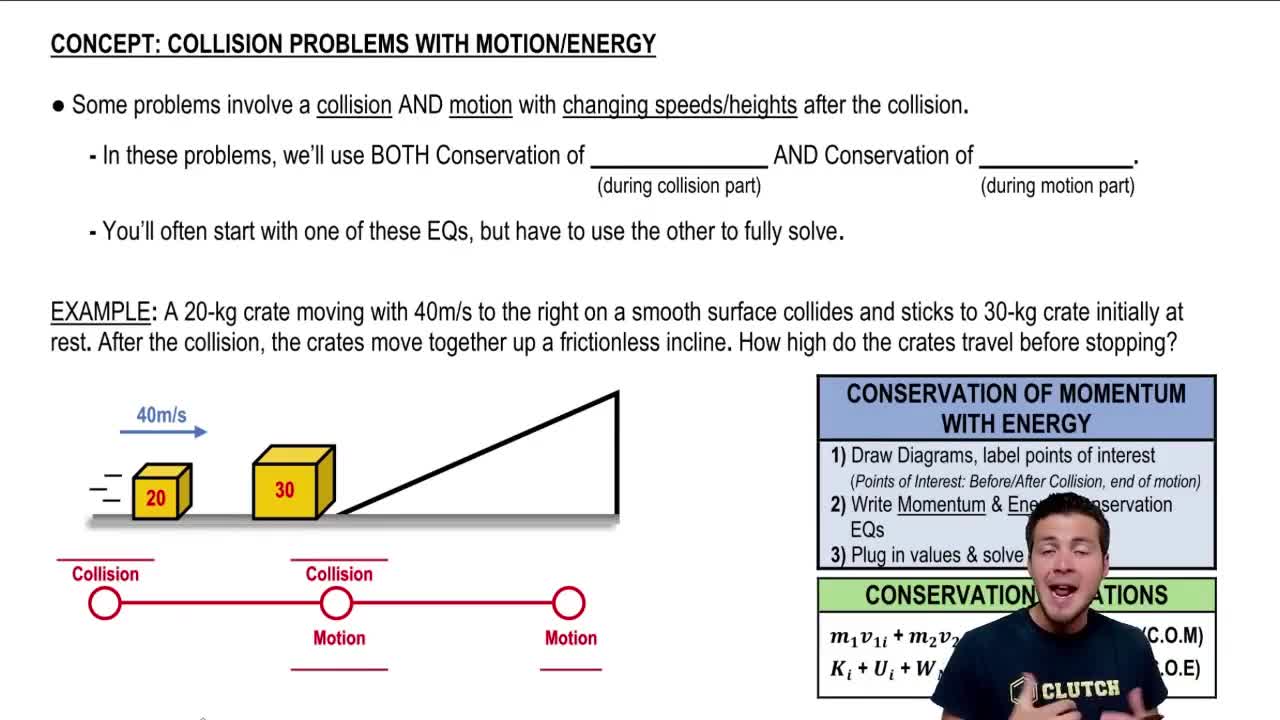
Kinetic energy is the energy an object possesses due to its motion, given by the formula KE = 1/2 mv², where m is mass and v is velocity. In collisions, kinetic energy can be transferred between objects, but not all kinetic energy is conserved in inelastic collisions. In this scenario, the electron's initial kinetic energy is partially converted into the energy of the emitted photon, affecting its final speed after the collision.
Recommended video:
Guided course
Collision Problems with Motion/Energy
Related Practice
Textbook Question
1
views
Textbook Question
The absorption spectrum of an atom consists of the wavelengths 200 nm, 300 nm, and 500 nm. b. What wavelengths are seen in the atom’s emission spectrum?
1
views
Textbook Question
What is the difference in the wavelengths emitted in a 199→2 transition and a 200→2 transition?
1
views
Textbook Question
The first three energy levels of the fictitious element X are shown in FIGURE P38.54. What wavelengths are observed in the absorption spectrum of element X? Express your answers in nm.
1
views
Textbook Question
The first three energy levels of the fictitious element X are shown in FIGURE P38.54. What is the ionization energy of element X?
1
views
Textbook Question
What wavelength photon does a hydrogen atom emit in a 200→199 transition?
1
views
