Ch 38: Quantization
Knight Calc - Physics for Scientists and Engineers 5th Edition
Knight Calc5th EditionPhysics for Scientists and EngineersISBN: 9780137344796Not the one you use?Change textbook
Chapter 38, Problem 54a

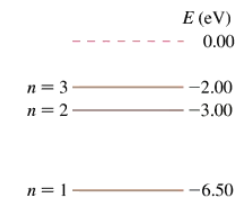
The first three energy levels of the fictitious element X are shown in FIGURE P38.54. What is the ionization energy of element X?

Verified step by step guidance
1
Step 1: Understand the concept of ionization energy. Ionization energy is the amount of energy required to completely remove an electron from the atom, moving it from its ground state to a state where it is free from the atom (essentially at an energy level of zero).
Step 2: Identify the ground state energy level of element X from the given figure. The ground state is the lowest energy level, typically denoted as E₁.
Step 3: Recognize that the ionization energy is the difference between the ground state energy (E₁) and the energy level of a free electron (which is 0 eV). This can be expressed mathematically as: E=-E1
Step 4: Substitute the value of E₁ from the figure into the formula. Ensure the energy value is in the correct units (e.g., electron volts, eV).
Step 5: Interpret the result. The ionization energy is the positive value of the magnitude of E₁, as it represents the energy required to remove the electron from the atom.

Verified video answer for a similar problem:

This video solution was recommended by our tutors as helpful for the problem above.
Was this helpful?

Key Concepts

Here are the essential concepts you must grasp in order to answer the question correctly.

Ionization Energy

Ionization energy is the amount of energy required to remove an electron from an atom or ion in its gaseous state. It is a critical concept in understanding how atoms interact and form ions. The first ionization energy refers specifically to the energy needed to remove the outermost electron, and it can be determined from the energy levels of an atom.
Recommended video:
Guided course
04:10
Intro to Energy & Types of Energy

Energy Levels

Energy levels, or electron shells, are regions around an atom's nucleus where electrons are likely to be found. Each energy level corresponds to a specific energy state, and electrons can move between these levels by absorbing or releasing energy. The difference in energy between these levels is crucial for calculating ionization energy.
Recommended video:
Guided course
04:10
Intro to Energy & Types of Energy

Energy Level Diagram

An energy level diagram visually represents the energy levels of electrons in an atom. It typically shows the energy levels as horizontal lines, with the lowest energy level at the bottom. By analyzing the diagram, one can determine the energy difference between levels, which directly relates to the ionization energy needed to remove an electron from the atom.
Recommended video:
Guided course
08:07
Work and PV Diagrams
Related Practice
Textbook Question

An electron confined in a one-dimensional box is observed, at different times, to have energies of 12 eV, 27 eV, and 48 eV. What is the length of the box?

1
views

Textbook Question

The absorption spectrum of an atom consists of the wavelengths 200 nm, 300 nm, and 500 nm. b. What wavelengths are seen in the atom’s emission spectrum?

1
views
Textbook Question

A muon—a subatomic particle with charge −e and a mass 207 times that of an electron—is confined in a 15-pm-long, one-dimensional box. ( 1pm=1picometer=10−12 m.) What is the wavelength, in nm, of the photon emitted in a quantum jump from n = 2 to n = 1?

1
views
Textbook Question

The first three energy levels of the fictitious element X are shown in FIGURE P38.54. What wavelengths are observed in the absorption spectrum of element X? Express your answers in nm.

1
views
Textbook Question

The first three energy levels of the fictitious element X were shown in Figure P38.54. An electron with a speed of 1.4×10⁶ m/s collides with an atom of element X. Shortly afterward, the atom emits a photon with a wavelength of 1240 nm. What was the electron’s speed after the collision? Assume that, because the atom is much more massive than the electron, the recoil of the atom is negligible. Hint: The energy of the photon is not the energy transferred to the atom in the collision.

2
views
Textbook Question

An electron confined in a one-dimensional box emits a 200 nm photon in a quantum jump from n = 2 to n = 1. What is the length of the box?

1
views