
Astronomers estimate that a 2.0-km-diameter asteroid collides with the Earth once every million years. The collision could pose a threat to life on Earth. Assume a spherical asteroid has a mass of 3200 kg for each cubic meter of volume and moves toward the Earth at 15 km/s. How much destructive energy could be released when it embeds itself in the Earth?
An astronaut of mass 210 kg including his suit and jet pack wants to acquire a velocity of 2.0 m/s to move back toward his space shuttle. Assuming the jet pack can eject gas with a velocity of 35 m/s, what mass of gas will need to be ejected?
Verified step by step guidance
Verified video answer for a similar problem:
Key Concepts
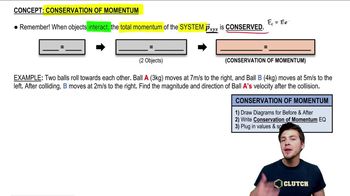
Conservation of Momentum
Rocket Equation
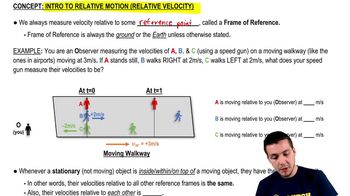
Relative Velocity
A rifle is aimed at a 2.0-kg block of wood along an inclined plane making an angle of 25°, as shown in Fig. 9–59. A 9.5-g bullet is fired at 760 m/s and becomes embedded in the block. How far up the incline does the block/bullet slide?
(a) Ignore the friction.
(b) Assume μₖ = 0.33.
A 5.5-kg object moving in the +𝓍 direction at 6.5 m/s collides head-on with an 8.0-kg object moving in the ―𝓍 direction at 4.0 m/s. Determine the final velocity of each object if the 5.5-kg object is at rest after the collision.
A fake hockey puck of mass 4m has been rigged to explode. Initially the puck is at rest on a frictionless ice rink. Then it bursts into three pieces. One chunk, of mass m, slides across the ice at velocity vî. Another chunk, of mass 2m, slides across the ice at velocity 2v ĵ. Determine the velocity of the third chunk.
The gravitational slingshot effect. Figure 9–62 shows the planet Saturn moving in the negative 𝓍 direction at its orbital speed (with respect to the Sun) of 9.6 km/s. The mass of Saturn is 5.69 x 10²⁶ kg. A spacecraft with mass 825 kg approaches Saturn. When far from Saturn, it moves in the +𝓍 direction at 10.4 km/s. The gravitational attraction of Saturn (a conservative force) acting on the spacecraft causes it to swing around the planet (orbit shown as dashed line) and head off in the opposite direction. Using momentum conservation in one dimension, estimate the final speed of the spacecraft after it is far enough away to be considered free of Saturn’s gravitational pull. Assume the spacecraft does not affect the orbit of Saturn whose mass is so much larger.
In order to convert a tough split in bowling, it is necessary to strike the pin a glancing blow as shown in Fig. 9–64. Assume that the bowling ball, traveling at 14.0 m/s just before it strikes the pin, has five times the mass of a pin and that the pin goes off at 75° from the original direction of the ball. Calculate the speed of the pin and (b) of the ball just after collision.
