
A gun fires a bullet vertically into a 1.40-kg block of wood at rest on a thin horizontal sheet, Fig. 9β54. If the bullet has a mass of 15.0 g and a speed of 230 m/s, how high will the block rise into the air after the bullet becomes embedded in it?
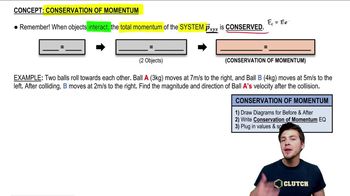
A 5.5-kg object moving in the +π direction at 6.5 m/s collides head-on with an 8.0-kg object moving in the βπ direction at 4.0 m/s. Determine the final velocity of each object if the 5.5-kg object is at rest after the collision.
Verified step by step guidance
Verified video answer for a similar problem:
Key Concepts
Conservation of Momentum
Momentum Calculation
Elastic vs. Inelastic Collisions
Astronomers estimate that a 2.0-km-diameter asteroid collides with the Earth once every million years. The collision could pose a threat to life on Earth. Assume a spherical asteroid has a mass of 3200 kg for each cubic meter of volume and moves toward the Earth at 15 km/s. How much destructive energy could be released when it embeds itself in the Earth?
A rifle is aimed at a 2.0-kg block of wood along an inclined plane making an angle of 25Β°, as shown in Fig. 9β59. A 9.5-g bullet is fired at 760 m/s and becomes embedded in the block. How far up the incline does the block/bullet slide?
(a) Ignore the friction.
(b) Assume ΞΌβ = 0.33.
An astronaut of mass 210 kg including his suit and jet pack wants to acquire a velocity of 2.0 m/s to move back toward his space shuttle. Assuming the jet pack can eject gas with a velocity of 35 m/s, what mass of gas will need to be ejected?
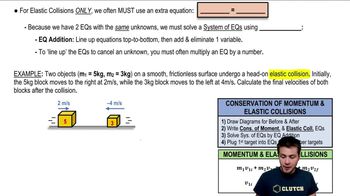
A 5.5-kg object moving in the +π direction at 6.5 m/s collides head-on with an 8.0-kg object moving in the βπ direction at 4.0 m/s. Determine the final velocity of each object if the collision is elastic.
A 5.5-kg object moving in the +π direction at 6.5 m/s collides head-on with an 8.0-kg object moving in the βπ direction at 4.0 m/s. Determine the final velocity of each object if the objects stick together.
