
Ch 11: Impulse and Momentum
Knight Calc - Physics for Scientists and Engineers 5th Edition
Knight Calc5th EditionPhysics for Scientists and EngineersISBN: 9780137344796Not the one you use?Change textbook
Chapter 11, Problem 13

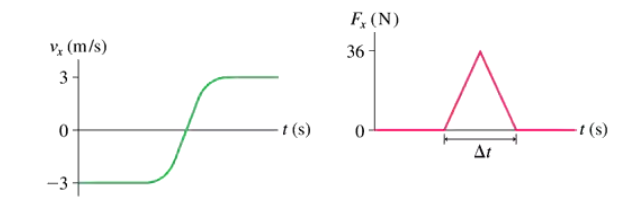
A 600 g air-track glider collides with a spring at one end of the track. FIGURE EX11.13 shows the glider's velocity and the force exerted on the glider by the spring. How long is the glider in contact with the spring?

Verified step by step guidance
1
Convert the mass of the glider from grams to kilograms, as SI units are required for calculations. Use the conversion: \( 1 \ \text{g} = 0.001 \ \text{kg} \). Thus, \( m = 600 \ \text{g} = 0.6 \ \text{kg} \).
Understand that the force exerted by the spring on the glider is related to the glider's acceleration through Newton's second law: \( F = m \cdot a \). Rearrange this to find acceleration: \( a = \frac{F}{m} \).
From the graph provided (FIGURE EX11.13), determine the force \( F \) as a function of time \( t \). Use this to calculate the acceleration \( a(t) \) at different points in time.
Recognize that the glider's velocity changes due to the spring's force. The relationship between velocity and acceleration is given by \( v(t) = v_0 + \int a(t) \cdot dt \), where \( v_0 \) is the initial velocity. Use this to find when the velocity becomes zero, as this marks the end of contact with the spring.
Integrate the force (or acceleration) over time to determine the total time of contact. This involves solving \( \int F(t) \cdot dt = m \cdot \Delta v \), where \( \Delta v \) is the change in velocity (from initial velocity to zero).

Verified video answer for a similar problem:

This video solution was recommended by our tutors as helpful for the problem above.
Video duration:
5m
Was this helpful?

Key Concepts

Here are the essential concepts you must grasp in order to answer the question correctly.

Conservation of Momentum

The conservation of momentum states that in a closed system, the total momentum before an event must equal the total momentum after the event, provided no external forces act on it. In the context of the glider and spring collision, understanding how momentum is transferred during the interaction is crucial for analyzing the motion of the glider.
Recommended video:
Guided course
05:58
Conservation Of Momentum

Hooke's Law

Hooke's Law describes the relationship between the force exerted by a spring and the displacement of the spring from its equilibrium position. It states that the force exerted by the spring is proportional to the distance it is compressed or stretched, which is essential for determining the force acting on the glider during its contact with the spring.
Recommended video:
Guided course
05:27
Spring Force (Hooke's Law)

Impulse and Momentum

Impulse is defined as the change in momentum of an object when a force is applied over a period of time. The relationship between impulse and momentum is key to solving the problem, as it allows us to calculate the duration of contact between the glider and the spring by analyzing the force exerted and the resulting change in the glider's velocity.
Recommended video:
Guided course
06:00
Impulse & Impulse-Momentum Theorem
Related Practice