
A dehumidifier removes water vapor from air and has been referred to as a “refrigerator with an open door.” The humid air is pulled in by a fan and passes over a cold coil, whose temperature is less than the dew point, and some of the air’s water condenses. After this water is extracted, the air is warmed back to its original temperature and sent into the room. In a well-designed dehumidifier, the heat that is removed by the cooling coil mostly comes from the condensation of water vapor to liquid, and this heat is used to re-warm the air. Estimate how much water is removed in 1.0 h by an ideal dehumidifier, if the temperature of the room is 25°C, the water condenses at 8°C, and the dehumidifier does work at the rate of 550 W of electrical power.
- Ch. 01 - Introduction, Measurement, Estimating10
- Ch. 02 - Describing Motion: Kinematics in One Dimension30
- Ch. 03 - Kinematics in Two or Three Dimensions; Vectors15
- Ch. 04 - Dynamics: Newton's Laws of Motion16
- Ch. 05 - Using Newton's Laws: Friction, Circular Motion, Drag Forces22
- Ch. 06 - Gravitation and Newton's Synthesis10
- Ch. 07 - Work and Energy21
- Ch. 08 - Conservation of Energy33
- Ch. 09 - Linear Momentum26
- Ch. 10 - Rotational Motion41
- Ch. 11 - Angular Momentum; General Rotation27
- Ch. 12 - Static Equilibrium; Elasticity and Fracture27
- Ch. 13 - Fluids28
- Ch. 14 - Oscillations14
- Ch. 15 - Wave Motion35
- Ch. 16 - Sound5
- Ch. 17 - Temperature, Thermal Expansion, and the Ideal Gas Law40
- Ch. 18 - Kinetic Theory of Gases18
- Ch. 19 - Heat and the First Law of Thermodynamics31
- Ch. 20 - Second Law of Thermodynamics32
- Ch. 21 - Electric Charge and Electric Field7
- Ch. 23 - Electric Potential20
- Ch. 24 - Capacitance, Dielectrics, Electric Energy, Storage15
- Ch. 25 - Electric Current and Resistance32
- Ch. 26 - DC Circuits22
- Ch. 27 - Magnetism21
- Ch. 28 - Sources of Magnetic Field24
- Ch. 29 - Electromagnetic Induction and Faraday's Law21
- Ch. 30 - Inductance, Electromagnetic Oscillations, and AC Circuits42
- Ch. 31 - Maxwell's Equations and Electromagnetic Waves25
- Ch. 32 - Light: Reflection and Refraction42
- Ch. 33 - Lenses and Optical Instruments21
- Ch. 34 - The Wave Nature of Light: Interference and Polarization26
- Ch. 35 - Diffraction24
- Ch. 36 - The Special Theory of Relativity29
- Ch. 38 - Quantum Mechanics1
- Ch. 40 - Molecules and Solids6
- Ch. 43 - Elementary Particles3
- Ch. 44 - Astrophysics and Cosmology9
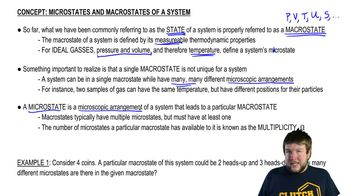
A bowl contains many red, orange, and green jelly beans, in equal numbers. You are to make a line of 3 jelly beans by randomly taking 3 beans from the bowl. Construct a table showing the number of microstates that correspond to each macrostate. Then, determine the probability of all 3 beans red.
 Verified step by step guidance
Verified video answer for a similar problem:

Key Concepts
Microstates and Macrostates
 06:41
06:41
Combinatorics
Probability
 04:03
04:03A bowl contains many red, orange, and green jelly beans, in equal numbers. You are to make a line of 3 jelly beans by randomly taking 3 beans from the bowl. Construct a table showing the number of microstates that correspond to each macrostate.
Trees can help a bit to offset the buildup of CO₂ due to burning coal and other fossil fuels. CO₂ can be absorbed by tree foliage. Trees use the carbon to grow, and release O₂ into the atmosphere. Suppose a refrigerator uses 600 kWh of electricity per year (about 2 x 10⁹ J) from a 33% efficient coal-fired power plant. Burning 1 kg of coal releases about 2 x 10⁷ J of energy. Assume coal is all carbon, which when burned in air becomes CO₂.
(a) How much coal is burned per year to run this refrigerator?
(b) Assuming a forest can capture 1700 kg of carbon per hectare ( = 10, 000 m²) per year, estimate how many square meters of forest are needed to capture the carbon (in the form now of CO₂) emitted by the refrigerator in (a).
Suppose a heat pump has a stationary bicycle attachment that allows you to provide the work instead of using an electrical wall outlet. If your heat pump has a coefficient of performance of 2.0 and you can cycle at a racing pace output of about 200 W for a half hour, how much heat can you provide?
Rank the following five-card hands in order of increasing probability: (a) four aces and a king; (b) six of hearts, eight of diamonds, queen of clubs, three of hearts, jack of spades; (c) two jacks, two queens, and an ace; and (d) any hand having no two equal-value cards (no pairs, etc.). Discuss your ranking in terms of microstates and macrostates.