A parallel-plate capacitor with a 1.0 mm plate separation is charged to 75 V. With what kinetic energy, in eV, must a proton be launched from the negative plate if it is just barely able to reach the positive plate?
Ch 37: The Foundations of Modern Physics
Knight Calc5th EditionPhysics for Scientists and EngineersISBN: 9780137344796Not the one you use?Change textbook
Chapter 37, Problem 19
How many electrons, protons, and neutrons are contained in the following atoms or ions: (a) ¹⁰B, (b) ¹³N⁺, and (c) ¹⁷O⁺⁺⁺?
Verified step by step guidance1
Step 1: Understand the notation of the given atoms or ions. The superscript number (e.g., ¹⁰ in ¹⁰B) represents the mass number, which is the sum of protons and neutrons in the nucleus. The subscript number (if present) or the atomic number of the element (from the periodic table) represents the number of protons in the nucleus.
Step 2: For each atom or ion, determine the number of protons using the atomic number of the element. For example, boron (B) has an atomic number of 5, nitrogen (N) has an atomic number of 7, and oxygen (O) has an atomic number of 8.
Step 3: Calculate the number of neutrons by subtracting the atomic number (number of protons) from the mass number. For example, for ¹⁰B, the number of neutrons is 10 - 5 = 5.
Step 4: Determine the number of electrons for each atom or ion. For neutral atoms, the number of electrons equals the number of protons. For ions, adjust the number of electrons based on the charge. For example, ¹³N⁺ has one less electron than the number of protons, and ¹⁷O⁺⁺⁺ has three fewer electrons than the number of protons.
Step 5: Summarize the results for each atom or ion, listing the number of electrons, protons, and neutrons. Ensure the calculations align with the atomic structure and charge of each species.

Verified video answer for a similar problem:
This video solution was recommended by our tutors as helpful for the problem above.
Video duration:
5mWas this helpful?
Key Concepts
Here are the essential concepts you must grasp in order to answer the question correctly.
Atomic Structure
Atoms consist of three primary subatomic particles: protons, neutrons, and electrons. Protons are positively charged and reside in the nucleus, while neutrons are neutral and also found in the nucleus. Electrons are negatively charged and orbit the nucleus in electron shells. The number of protons defines the element, while the total number of protons and neutrons gives the atomic mass.
Recommended video:
Guided course
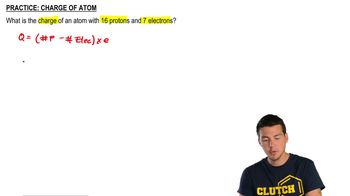
Charge of Atom
Ions
Ions are atoms or molecules that have gained or lost one or more electrons, resulting in a net electric charge. Cations are positively charged ions formed by losing electrons, while anions are negatively charged ions formed by gaining electrons. The charge of an ion affects the number of electrons relative to protons, which is crucial for determining the overall composition of the atom or ion.
Isotopes
Isotopes are variants of a particular chemical element that have the same number of protons but different numbers of neutrons. This difference in neutron count results in varying atomic masses. For example, ¹⁰B, ¹³N, and ¹⁷O are isotopes of boron, nitrogen, and oxygen, respectively, and understanding their isotopic nature is essential for calculating the total number of neutrons in each atom or ion.
Related Practice
Textbook Question
1
views
Textbook Question
Express in eV (or keV or MeV if more appropriate): The kinetic energy of an electron moving with a speed of 5.0 x 10⁶ m/s .
1
views
Textbook Question
Consider the gold isotope 197Au. The gold nucleus has a diameter of 14.0 fm. What is the density of matter in a gold nucleus?
Textbook Question
What is the velocity, as a fraction of c, of an electron with 2.0 GeV total energy? Hint: This problem uses relativity.
1
views
Textbook Question
Determine the speed of a 15 MeV helium atom.
Textbook Question
Identify the isotope that is 11 times as heavy as ¹²C and has 18 times as many protons as ⁶Li . Give your answer in the form ᴬS, where S is the symbol for the element. See Appendix C: Atomic and Nuclear Data.
1
views