
Textbook Question
A parallel-plate capacitor with a 1.0 mm plate separation is charged to 75 V. With what kinetic energy, in eV, must a proton be launched from the negative plate if it is just barely able to reach the positive plate?
1
views

 Verified step by step guidance
 06:07
06:07
 20:32
20:32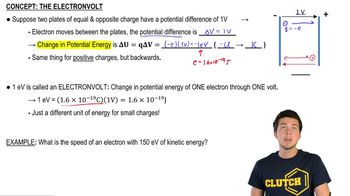 05:37
05:37A parallel-plate capacitor with a 1.0 mm plate separation is charged to 75 V. With what kinetic energy, in eV, must a proton be launched from the negative plate if it is just barely able to reach the positive plate?
A 0.80-μm-diameter oil droplet is observed between two parallel electrodes spaced 11 mm apart. The droplet hangs motionless if the upper electrode is 20 V more positive than the lower electrode. The density of the oil is 885 kg/m3. Does the droplet have a surplus or a deficit of electrons? How many?
How many electrons, protons, and neutrons are contained in the following atoms or ions: (a) ¹⁰B, (b) ¹³N⁺, and (c) ¹⁷O⁺⁺⁺?
An electron in a cathode-ray beam passes between 2.5-cm-long parallel-plate electrodes that are 5.0 mm apart. A 2.0 mT, 2.5-cm-wide magnetic field is perpendicular to the electric field between the plates. The electron passes through the electrodes without being deflected if the potential difference between the plates is 600 V. If the potential difference between the plates is set to zero, what is the electron's radius of curvature in the magnetic field?
Determine the speed of a 15 MeV helium atom.
Identify the isotope that is 11 times as heavy as ¹²C and has 18 times as many protons as ⁶Li . Give your answer in the form ᴬS, where S is the symbol for the element. See Appendix C: Atomic and Nuclear Data.