Ch. 31 - Maxwell's Equations and Electromagnetic Waves
Giancoli Douglas - Physics for Scientists and Engineers 5th edition
Giancoli Douglas5th editionPhysics for Scientists and EngineersISBN: 9780137488179Not the one you use?Change textbook
Chapter 30, Problem 65

A powerful laser portrayed in a movie provides a 3-mm-diameter beam of green light with a power of 3 W. A good agent inside a spacecraft aims the laser beam at an enemy astronaut hovering outside. The mass of the enemy astronaut is 120 kg and the spacecraft 185,000 kg. (a) Determine the “radiation-pressure” force exerted on the enemy by the laser beam assuming her suit is perfectly reflecting. (b) If the enemy is 30 m from the spacecraft’s center of mass, estimate the gravitational force the spacecraft exerts on the enemy. (c) Which of the two forces is larger, and by what factor?

Verified step by step guidance
1
Step 1: Calculate the radiation pressure force exerted by the laser beam. For a perfectly reflecting surface, the radiation pressure is given by the formula: \( P = \frac{2I}{c} \), where \( I \) is the intensity of the laser beam and \( c \) is the speed of light. The intensity \( I \) can be calculated as \( I = \frac{P_{laser}}{A} \), where \( P_{laser} \) is the power of the laser and \( A \) is the cross-sectional area of the beam. The area \( A \) is \( \pi r^2 \), where \( r \) is the radius of the beam (half the diameter).
Step 2: Use the formula for gravitational force to calculate the force exerted by the spacecraft on the enemy astronaut. The gravitational force is given by \( F_g = \frac{G m_1 m_2}{r^2} \), where \( G \) is the gravitational constant, \( m_1 \) is the mass of the spacecraft, \( m_2 \) is the mass of the astronaut, and \( r \) is the distance between the two masses.
Step 3: Compare the two forces calculated in steps 1 and 2. To determine which force is larger, compare the magnitudes of the radiation pressure force and the gravitational force. To find the factor by which one force is larger than the other, divide the larger force by the smaller force.
Step 4: Analyze the results conceptually. Radiation pressure is typically very small compared to gravitational forces in most scenarios. However, the specific values in this problem will determine the outcome. Reflect on the implications of the results for the astronaut's motion.
Step 5: Summarize the findings. State which force is larger and by what factor, based on the calculations. Discuss the physical significance of the comparison in the context of the problem, such as the practicality of the laser beam affecting the astronaut's motion compared to gravitational attraction.

Verified video answer for a similar problem:

This video solution was recommended by our tutors as helpful for the problem above.
Video duration:
10m
Was this helpful?

Key Concepts

Here are the essential concepts you must grasp in order to answer the question correctly.

Radiation Pressure

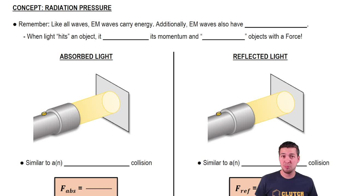
Radiation pressure is the force exerted by electromagnetic radiation on a surface. When light strikes a perfectly reflecting surface, it transfers momentum, resulting in a pressure that can be calculated using the formula P = I/c, where P is the pressure, I is the intensity of the light, and c is the speed of light. In this scenario, the laser beam's power and area determine the intensity, which is crucial for calculating the force on the enemy astronaut.
Recommended video:
Guided course
07:51
Radiation Pressure

Gravitational Force

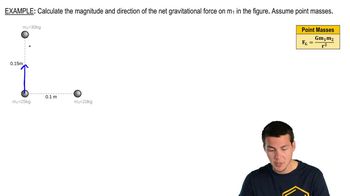
Gravitational force is the attractive force between two masses, described by Newton's law of universal gravitation. The force can be calculated using the formula F = G(m1*m2)/r^2, where G is the gravitational constant, m1 and m2 are the masses of the objects, and r is the distance between their centers of mass. In this case, the gravitational force between the spacecraft and the enemy astronaut is essential for understanding the interaction between them.
Recommended video:
Guided course
05:41
Gravitational Forces in 2D

Comparative Force Analysis

Comparative force analysis involves evaluating two or more forces to determine their relative magnitudes. In this problem, we need to compare the radiation pressure force exerted by the laser beam on the enemy astronaut with the gravitational force from the spacecraft. By calculating both forces, we can identify which one is larger and by what factor, providing insight into the dynamics of the situation.
Recommended video:
Guided course
05:00
Dimensional Analysis
Related Practice
Textbook Question

What is the maximum power level of a radio station so as to avoid electrical breakdown of air at a distance of 0.75 m from the transmitting antenna? Assume the antenna is a point source. Air breaks down in an electric field of about 3 x 10⁶ V/m.

1
views
Textbook Question

Show that displacement current, ε₀ (dΦE/dt), has the SI units of amperes.

1
views
Textbook Question

Imagine that a steady current I flows in a straight cylindrical wire of radius R₀ and resistivity ρ.

(a) If the current is then changed at a rate dI/dt, show that a displacement current ID exists in the wire of magnitude ε₀ρ(dI/dt).

(b) If the current in a copper wire is changed at the rate of 1.0 A/ms, determine the magnitude of ID.

(c) Determine the magnitude of the magnetic field BD created by ID at the surface of a copper wire with R₀ = 1.00 mm. Compare (as a ratio) BD with the field created at the surface of the wire by a steady current of 1.0 A.

1
views
Textbook Question

What length of antenna would be appropriate for a portable device that could receive satellite TV?

1
views
Textbook Question

Radio-controlled clocks throughout the United States receive a radio signal from a transmitter in Fort Collins, Colorado, that accurately (within a microsecond) marks the beginning of each minute. A slight amount of time is added by a clock at any location to correct for the signal travel time to the clock from Fort Collins. Assuming Fort Collins is no more than 3000 km from any point in the U.S., what is the longest travel-time delay?

Textbook Question

The average intensity of a particular TV station’s signal is 1.0 x 10⁻¹³ W/m2 when it arrives at a 33-cm-diameter satellite TV antenna. (a) Calculate the total energy received by the antenna during 3.0 hours of viewing this station’s programs. (b) Estimate the amplitudes of the E and B fields of the EM wave.