
Ch. 12 - Static Equilibrium; Elasticity and Fracture
Giancoli Douglas - Physics for Scientists and Engineers 5th edition
Giancoli Douglas5th editionPhysics for Scientists and EngineersISBN: 9780137488179Not the one you use?Change textbook
Chapter 12, Problem 71

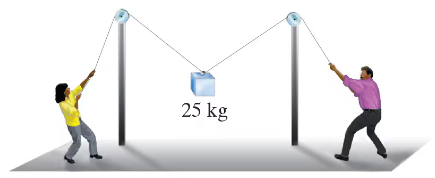
A 25-kg object is being lifted by two people pulling on the ends of a 1.15-mm-diameter nylon cord that goes over two 3.00-m-high poles that are 4.5 m apart, as shown in Fig. 12–93. How high above the floor will the object be when the cord breaks?
Two people pull on a nylon cord over poles, lifting a 25-kg object suspended between them.

Verified step by step guidance
1
Determine the breaking force of the nylon cord using the tensile strength of nylon and the cross-sectional area of the cord. The cross-sectional area can be calculated using the formula: A=πr2/, where r is the radius of the cord (half the diameter).
Calculate the tension in the cord when the object is lifted. The tension is related to the weight of the object and the geometry of the setup. Use the weight of the object, W=mg, where m is the mass of the object and g is the acceleration due to gravity.
Analyze the geometry of the cord and the forces involved. The cord forms a triangle with the poles and the object. Use trigonometry to relate the height of the object above the floor to the tension in the cord. The horizontal and vertical components of the tension must balance the forces acting on the object.
Set the maximum tension in the cord equal to the breaking force calculated in step 1. Solve for the height of the object above the floor using the trigonometric relationships derived in step 3.
Verify the solution by checking that the calculated height satisfies the conditions of the problem, including the geometry of the setup and the breaking force of the cord.

Verified video answer for a similar problem:

This video solution was recommended by our tutors as helpful for the problem above.
Video duration:
9m
Was this helpful?

Key Concepts

Here are the essential concepts you must grasp in order to answer the question correctly.

Tension in a Cord

Tension is the force transmitted through a cord or rope when it is pulled tight by forces acting from opposite ends. In this scenario, the tension in the nylon cord is crucial as it determines how much weight the cord can support before breaking. The maximum tension is influenced by the weight of the object and the angle at which the cord is pulled.
Recommended video:
Guided course
06:34
Calculating Tension in a Pendulum with Energy Conservation

Weight and Gravitational Force

Weight is the force exerted by gravity on an object, calculated as the product of mass and gravitational acceleration (W = mg). For the 25-kg object, its weight is approximately 245 N (using g ≈ 9.81 m/s²). Understanding the weight is essential to determine how much force the cord must withstand before it breaks.
Recommended video:
Guided course
07:32
Weight Force & Gravitational Acceleration

Breaking Strength of Materials

The breaking strength of a material is the maximum stress that it can withstand before failure. For the nylon cord, this value is critical to know, as it dictates the maximum load the cord can handle. If the tension in the cord exceeds this breaking strength, the cord will snap, leading to the object falling.
Recommended video:
Guided course
04:32
Dielectric Breakdown
Related Practice
Textbook Question

A uniform 95-kg flagpole of length 8.4 m is being erected by pulling on a rope attached 2/3 of the way to the top (Fig. 12–94). When the pole is inclined at 35° and the rope makes an angle with the ground of 18°, what is the tension in the rope?

2
views
Textbook Question

A uniform beam of mass M and length ℓ is mounted on a hinge at a wall as shown in Fig. 12–101. It is held in a horizontal position by a wire making an angle θ as shown. A mass m is placed on the beam a distance x from the wall, and this distance can be varied. Determine, as a function of x, the components of the force exerted by the beam on the hinge.

1
views
Textbook Question

A steel rod of radius R = 15 cm and length ℓ₀ stands upright on a firm surface. A 78-kg man climbs atop the rod. When a metal is compressed, each atom throughout its bulk moves closer to its neighboring atom by exactly the same fractional amount. If iron atoms in steel are normally 2.0 x 10⁻¹⁰ m apart, by what distance did this interatomic spacing have to change in order to produce the normal force required to support the man? [Note: Neighboring atoms repel each other, and this repulsion accounts for the observed normal force.]

3
views
Textbook Question

A pole projects horizontally from the front wall of a shop. A 6.1-kg sign hangs from the pole at a point 2.2 m from the wall (Fig. 12–88). If the pole is not to fall off, there must be another torque exerted to balance it. What exerts this torque? Use a diagram to show how this torque must act.

10
views
Textbook Question

When a mass of 25 kg is hung from the middle of a fixed straight aluminum wire, the wire sags to make an angle of 12° with the horizontal as shown in Fig. 12–90. Determine the radius of the wire.

1
views
Textbook Question

A pole projects horizontally from the front wall of a shop. A 6.1-kg sign hangs from the pole at a point 2.2 m from the wall (Fig. 12–88). Discuss whether compression, tension, and/or shear play a role in part (b).

1
views