

Ch. 12 - Static Equilibrium; Elasticity and Fracture
Giancoli Douglas - Physics for Scientists and Engineers 5th edition
Giancoli Douglas5th editionPhysics for Scientists and EngineersISBN: 9780137488179Not the one you use?Change textbook
Chapter 12, Problem 73

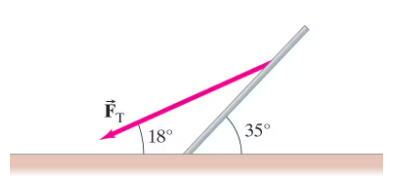
A uniform 95-kg flagpole of length 8.4 m is being erected by pulling on a rope attached 2/3 of the way to the top (Fig. 12–94). When the pole is inclined at 35° and the rope makes an angle with the ground of 18°, what is the tension in the rope?

Verified step by step guidance
1
Identify the forces acting on the flagpole: (1) the gravitational force acting downward at the center of mass of the pole, which is located at its midpoint, (2) the tension in the rope, and (3) the reaction force at the base of the pole.
Set up the torque equilibrium condition about the base of the pole. The net torque about the base must be zero because the pole is in static equilibrium. The torque due to the gravitational force is \( \tau_{gravity} = (m g) \cdot (\frac{L}{2}) \cdot \sin(\theta) \), where \( m \) is the mass of the pole, \( g \) is the acceleration due to gravity, \( L \) is the length of the pole, and \( \theta \) is the angle the pole makes with the ground.
The torque due to the tension in the rope is \( \tau_{tension} = T \cdot (\frac{2L}{3}) \cdot \cos(\phi) \), where \( T \) is the tension in the rope, \( \frac{2L}{3} \) is the distance from the base to the point where the rope is attached, and \( \phi \) is the angle the rope makes with the ground.
Set the sum of the torques equal to zero: \( \tau_{gravity} - \tau_{tension} = 0 \). Substitute the expressions for \( \tau_{gravity} \) and \( \tau_{tension} \) into this equation: \( (m g) \cdot (\frac{L}{2}) \cdot \sin(\theta) = T \cdot (\frac{2L}{3}) \cdot \cos(\phi) \).
Solve for the tension \( T \): \( T = \frac{(m g) \cdot (\frac{L}{2}) \cdot \sin(\theta)}{(\frac{2L}{3}) \cdot \cos(\phi)} \). Substitute the given values for \( m = 95 \ \text{kg} \), \( L = 8.4 \ \text{m} \), \( \theta = 35^\circ \), \( \phi = 18^\circ \), and \( g = 9.8 \ \text{m/s}^2 \) to calculate the tension.

Verified video answer for a similar problem:

This video solution was recommended by our tutors as helpful for the problem above.
Video duration:
10m
Was this helpful?

Key Concepts

Here are the essential concepts you must grasp in order to answer the question correctly.

Torque

Torque is a measure of the rotational force acting on an object. It is calculated as the product of the force applied and the distance from the pivot point to the line of action of the force. In this scenario, the torque created by the weight of the flagpole and the tension in the rope must be balanced to maintain equilibrium as the pole is inclined.
Recommended video:
Guided course
08:55
Net Torque & Sign of Torque

Trigonometry in Physics

Trigonometry is essential in physics for analyzing angles and distances in problems involving inclined planes and forces. In this case, the angles of inclination of the flagpole and the rope can be used to resolve the forces into their horizontal and vertical components, which is crucial for calculating the tension in the rope.

Equilibrium of Forces

The concept of equilibrium states that the sum of all forces and torques acting on an object must equal zero for it to remain at rest or in uniform motion. In this problem, the forces acting on the flagpole, including its weight and the tension in the rope, must be analyzed to ensure that they balance out, allowing for the calculation of the rope's tension.
Recommended video:
Related Practice
Textbook Question

A uniform beam of mass M and length ℓ is mounted on a hinge at a wall as shown in Fig. 12–101. It is held in a horizontal position by a wire making an angle θ as shown. A mass m is placed on the beam a distance x from the wall, and this distance can be varied. Determine, as a function of x, the components of the force exerted by the beam on the hinge.

1
views
Textbook Question

A steel rod of radius R = 15 cm and length ℓ₀ stands upright on a firm surface. A 78-kg man climbs atop the rod. When a metal is compressed, each atom throughout its bulk moves closer to its neighboring atom by exactly the same fractional amount. If iron atoms in steel are normally 2.0 x 10⁻¹⁰ m apart, by what distance did this interatomic spacing have to change in order to produce the normal force required to support the man? [Note: Neighboring atoms repel each other, and this repulsion accounts for the observed normal force.]

3
views
Textbook Question

When a mass of 25 kg is hung from the middle of a fixed straight aluminum wire, the wire sags to make an angle of 12° with the horizontal as shown in Fig. 12–90. Determine the radius of the wire.

1
views
Textbook Question

If 25 kg is the maximum mass m that a person can hold in a hand when the arm is positioned with a 105° angle at the elbow as shown in Fig. 12–102, what is the maximum force Fₘₐₓ that the biceps muscle exerts on the forearm? Assume the forearm and hand have a total mass of 2.0 kg with a cg that is 15 cm from the elbow, and that the biceps muscle attaches 5.0 cm from the elbow.

2
views
Textbook Question

A 25-kg object is being lifted by two people pulling on the ends of a 1.15-mm-diameter nylon cord that goes over two 3.00-m-high poles that are 4.5 m apart, as shown in Fig. 12–93. How high above the floor will the object be when the cord breaks?

1
views
Textbook Question

A pole projects horizontally from the front wall of a shop. A 6.1-kg sign hangs from the pole at a point 2.2 m from the wall (Fig. 12–88). Discuss whether compression, tension, and/or shear play a role in part (b).

1
views