Ch 38: Quantization
Knight Calc - Physics for Scientists and Engineers 5th Edition
Knight Calc5th EditionPhysics for Scientists and EngineersISBN: 9780137344796Not the one you use?Change textbook
Chapter 38, Problem 55b

The absorption spectrum of an atom consists of the wavelengths 200 nm, 300 nm, and 500 nm. b. What wavelengths are seen in the atom’s emission spectrum?

Verified step by step guidance
1
Understand the relationship between absorption and emission spectra: When an atom absorbs energy, electrons transition to higher energy levels. The emission spectrum occurs when these electrons return to lower energy levels, releasing energy in the form of light at specific wavelengths.
Recognize that the wavelengths seen in the emission spectrum correspond to the same energy transitions as those in the absorption spectrum. This is because the energy difference between levels is the same whether the electron is absorbing or emitting energy.
Use the formula for energy of a photon: \( E = \frac{hc}{\lambda} \), where \( h \) is Planck's constant, \( c \) is the speed of light, and \( \lambda \) is the wavelength. This formula shows that each wavelength corresponds to a specific energy transition.
Identify the wavelengths in the absorption spectrum: 200 nm, 300 nm, and 500 nm. These wavelengths represent the energy transitions during absorption, and the same wavelengths will appear in the emission spectrum.
Conclude that the emission spectrum of the atom will include the wavelengths 200 nm, 300 nm, and 500 nm, as these correspond to the energy transitions involved in both absorption and emission processes.

Verified video answer for a similar problem:

This video solution was recommended by our tutors as helpful for the problem above.
Was this helpful?

Key Concepts

Here are the essential concepts you must grasp in order to answer the question correctly.

Absorption Spectrum

An absorption spectrum is produced when an atom absorbs specific wavelengths of light, causing electrons to move from lower to higher energy levels. The absorbed wavelengths correspond to the energy differences between these levels, resulting in dark lines on a continuous spectrum. This spectrum is unique to each element, allowing for identification based on the specific wavelengths absorbed.
Recommended video:
Guided course
06:06
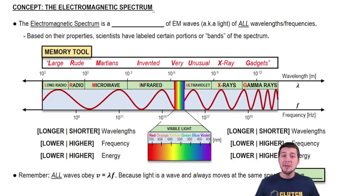
The Electromagnetic Spectrum

Emission Spectrum

An emission spectrum occurs when electrons in an atom return from higher energy levels to lower ones, releasing energy in the form of light. The emitted light appears as bright lines at specific wavelengths, which correspond to the energy differences between the levels. Like the absorption spectrum, the emission spectrum is characteristic of the element, revealing the same wavelengths that were absorbed.
Recommended video:
Guided course
06:06
The Electromagnetic Spectrum

Energy Level Transitions

Energy level transitions refer to the movement of electrons between quantized energy states within an atom. When an electron absorbs energy, it can jump to a higher energy level, while the release of energy during a transition back to a lower level results in the emission of light. The specific wavelengths observed in both absorption and emission spectra are determined by these transitions, making them fundamental to understanding atomic behavior.
Recommended video:
Guided course
04:10
Intro to Energy & Types of Energy