
Textbook Question
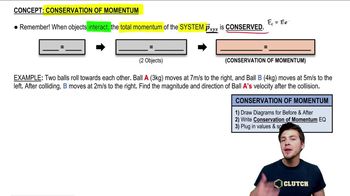
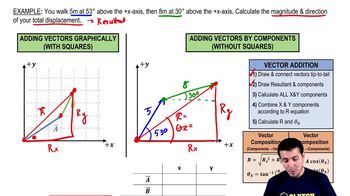
A 22-g bullet traveling 240 m/s penetrates a 2.0-kg block of wood and emerges going 130 m/s. If the block is stationary on a frictionless surface when hit, how fast does it move after the bullet emerges?
2
views

 Verified step by step guidance
 05:58
05:58
 07:30
07:30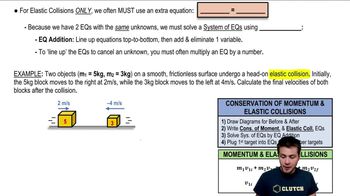 08:56
08:56A 22-g bullet traveling 240 m/s penetrates a 2.0-kg block of wood and emerges going 130 m/s. If the block is stationary on a frictionless surface when hit, how fast does it move after the bullet emerges?
The force on a bullet along the barrel of a firearm is given by the formula F = [740 ― (2.3 x 10⁵ s⁻¹ ) t] N over the time interval t = 0 to t = 3.0 x 10⁻³ s. Plot a graph of F versus t for t = 0 to t = 3.0 ms. Use the graph to estimate the impulse given the bullet.
A 195-kg projectile, fired with a speed of 116 m/s at a 60.0° angle, breaks into three pieces of equal mass at the highest point of its arc (where its velocity is horizontal). Two of the fragments move with the same speed right after the explosion as the entire projectile had just before the explosion; one of these moves vertically downward and the other horizontally. Determine the velocity of the third fragment immediately after the explosion.
A 7150-kg railroad car travels alone on a level frictionless track with a constant speed of 15.0 m/s. A 3650-kg load, initially at rest, is dropped onto the car. What will be the car’s new speed?
The force on a bullet along the barrel of a firearm is given by the formula F = [740 ― (2.3 x 10⁵ s⁻¹ ) t] N over the time interval t = 0 to t = 3.0 x 10⁻³ s. Plot a graph of F versus t for t = 0 to t = 3.0 ms.