
Textbook Question
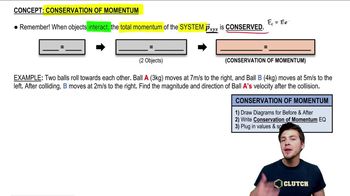
A 22-g bullet traveling 240 m/s penetrates a 2.0-kg block of wood and emerges going 130 m/s. If the block is stationary on a frictionless surface when hit, how fast does it move after the bullet emerges?
2
views
 Verified step by step guidance
 05:58
05:58
 06:07
06:07 04:44
04:44A 22-g bullet traveling 240 m/s penetrates a 2.0-kg block of wood and emerges going 130 m/s. If the block is stationary on a frictionless surface when hit, how fast does it move after the bullet emerges?
The force on a bullet along the barrel of a firearm is given by the formula F = [740 ― (2.3 x 10⁵ s⁻¹ ) t] N over the time interval t = 0 to t = 3.0 x 10⁻³ s. Plot a graph of F versus t for t = 0 to t = 3.0 ms. Use the graph to estimate the impulse given the bullet.
A 7150-kg railroad car travels alone on a level frictionless track with a constant speed of 15.0 m/s. A 3650-kg load, initially at rest, is dropped onto the car. What will be the car’s new speed?
The force on a bullet along the barrel of a firearm is given by the formula F = [740 ― (2.3 x 10⁵ s⁻¹ ) t] N over the time interval t = 0 to t = 3.0 x 10⁻³ s. Plot a graph of F versus t for t = 0 to t = 3.0 ms.
A mass mₐ = 2.0 kg, moving with velocity = (4.0 î + 5.0 ĵ ― 2.0 k̂) m/s, collides with mass m₈ = 3.0 kg, which is initially at rest. Immediately after the collision, mass mₐ is observed traveling at velocity = (― 2.0 î + 3.0 k̂) m/s. Find the velocity of mass m₈ after the collision. Assume no outside force acts on the two masses during the collision.
Croquet ball A moving at 4.3 m/s makes a head-on collision with ball B of equal mass initially at rest. Immediately after the collision, ball B moves forward at 3.0 m/s. What fraction of the initial kinetic energy is lost in the collision?