Ch 03: Motion in Two or Three Dimensions
Young & Freedman Calc - University Physics 14th Edition
Young & Freedman Calc14th EditionUniversity PhysicsISBN: 9780321973610Not the one you use?Change textbook
Chapter 3, Problem 8a

A remote-controlled car is moving in a vacant parking lot. The velocity of the car as a function of time is given by v=[5.00 m/s(0.0180 m/s3)t2]i^+[2.00 m/s+(0.550 m/s2)t]j^\(\vec{v}\) = \(\left\)[ 5.00~\(\mathrm{m/s}\) - (0.0180~\(\mathrm{m/s^3}\))t^2 \(\right\)] \(\hat{i}\) + \(\left\)[ 2.00~\(\mathrm{m/s}\) + (0.550~\(\mathrm{m/s^2}\))t \(\right\)] \(\hat{j}\). What are ax(t)a_{x}(t) and ay(t)a_{y}(t), the xx- and yy- components of the car's velocity as functions of time?

Verified step by step guidance
1
Identify the given velocity function of the car: \( \mathbf{v}(t) = [5.00 \text{ m/s} - (0.0180 \text{ m/s}^3)t^2]\hat{i} + [2.00 \text{ m/s} + (0.550 \text{ m/s}^2)t]\hat{j} \).
Understand that the velocity function is composed of two components: \( v_x(t) = 5.00 \text{ m/s} - (0.0180 \text{ m/s}^3)t^2 \) and \( v_y(t) = 2.00 \text{ m/s} + (0.550 \text{ m/s}^2)t \).
To find the acceleration components, differentiate the velocity components with respect to time. The acceleration is the derivative of velocity.
Calculate the x-component of acceleration: \( a_x(t) = \frac{d}{dt}[5.00 \text{ m/s} - (0.0180 \text{ m/s}^3)t^2] \).
Calculate the y-component of acceleration: \( a_y(t) = \frac{d}{dt}[2.00 \text{ m/s} + (0.550 \text{ m/s}^2)t] \).

Verified video answer for a similar problem:

This video solution was recommended by our tutors as helpful for the problem above.
Video duration:
1m
Was this helpful?

Key Concepts

Here are the essential concepts you must grasp in order to answer the question correctly.

Velocity as a Function of Time

Velocity as a function of time describes how the speed and direction of an object change over time. In this problem, the velocity is given as a vector with components in the x and y directions, each expressed as a function of time. Understanding this concept is crucial for determining how the car's motion evolves in both directions.
Recommended video:
Guided course
05:59
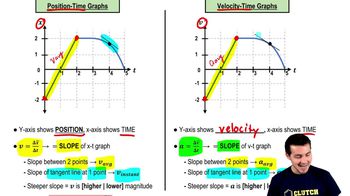
Velocity-Time Graphs & Acceleration

Differentiation

Differentiation is a mathematical process used to find the rate at which a quantity changes. In physics, it is often used to derive acceleration from velocity. For this problem, differentiating the velocity functions with respect to time will yield the acceleration components ax(t) and ay(t), which describe how the car's velocity changes in the x and y directions.
Recommended video:
Guided course
13:04
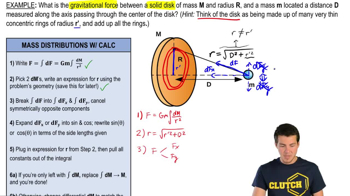
Gravitational Force from a Solid Disk

Vector Components

Vector components break down a vector into parts that align with the coordinate axes, typically x and y. Each component represents the influence of the vector in that direction. In this problem, the velocity vector is split into x and y components, allowing us to analyze the car's motion separately along each axis, which is essential for calculating ax(t) and ay(t).
Recommended video:
Guided course
07:30
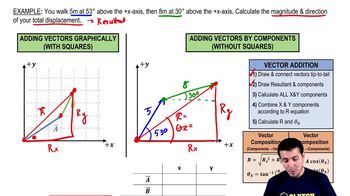
Vector Addition By Components
Related Practice
Textbook Question

A remote-controlled car is moving in a vacant parking lot. The velocity of the car as a function of time is given by v=[5.00 m/s(0.0180 m/s3)t2]i^+[2.00 m/s+(0.550 m/s2)t]j^\(\vec{v}\) = \(\left\)[ 5.00~\(\mathrm{m/s}\) - (0.0180~\(\mathrm{m/s^3}\))t^2 \(\right\)] \(\hat{i}\) + \(\left\)[ 2.00~\(\mathrm{m/s}\) + (0.550~\(\mathrm{m/s^2}\))t \(\right\)] \(\hat{j}\). What are the magnitude and direction of the car's velocity at t=8.00 st=8.00\(\text{ }\)s? (b) What are the magnitude and direction of the car's acceleration at t=8.00 st=8.00\(\text{ }\)s?

5
views
Textbook Question

The coordinates of a bird flying in the xy-plane are given by x(t) = αt and y(t) = 3.0 m − βt2, where α = 2.4 m/s and β = 1.2 m/s2. Calculate the magnitude and direction of the bird's velocity and acceleration at t = 2.0 s.

4
views
Textbook Question

The coordinates of a bird flying in the xy-plane are given by x(t) = αt and y(t) = 3.0 m − βt2, where α = 2.4 m/s and β = 1.2 m/s2. (a) Sketch the path of the bird between t = 0 and t = 2.0 s.

8
views
Textbook Question

The coordinates of a bird flying in the xy-plane are given by x(t) = αt and y(t) = 3.0 m − βt2, where α = 2.4 m/s and β = 1.2 m/s2. Calculate the velocity and acceleration vectors of the bird as functions of time.

1
views
Textbook Question

A daring 510 N swimmer dives off a cliff with a running horizontal leap, as shown in Fig. E3.10. What must her minimum speed be just as she leaves the top of the cliff so that she will miss the ledge at the bottom, which is 1.75 m wide and 9.00 m below the top of the cliff?

5
views
Textbook Question

A physics book slides off a horizontal tabletop with a speed of 1.10 m/s. It strikes the floor in 0.480 s. Ignore air resistance. Find the height of the tabletop above the floor.

2
views