Ch. 08 - Conservation of Energy
Giancoli Douglas - Physics for Scientists and Engineers 5th edition
Giancoli Douglas5th editionPhysics for Scientists and EngineersISBN: 9780137488179Not the one you use?Change textbook
Chapter 8, Problem 22c

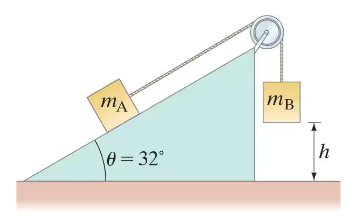
Two masses are connected by a string as shown in Fig. 8–35. Mass mA = 3.5 kg rests on a frictionless inclined plane, while mB = 5.0 kg is initially held at a height of h = 0.75 m above the floor. Use conservation of energy to find the velocity of the masses just before mB hits the floor. You should get the same answer as in part (b).

Verified step by step guidance
1
Identify the system: The two masses (m_A and m_B) are connected by a string, and the system is influenced by gravity and the inclined plane. Since the plane is frictionless, no energy is lost to friction. The problem involves using the principle of conservation of energy.
Write the total mechanical energy of the system at the initial state: The initial energy consists of the gravitational potential energy of m_B (m_B * g * h) and the gravitational potential energy of m_A due to its position on the inclined plane. Since m_A is not moving initially, its kinetic energy is zero.
Write the total mechanical energy of the system at the final state: Just before m_B hits the floor, m_B has lost all its gravitational potential energy, and both masses have gained kinetic energy. The kinetic energy of each mass is (1/2) * m * v^2, where v is the velocity of the masses (they share the same velocity due to the string). Additionally, m_A has moved up the incline, gaining gravitational potential energy (m_A * g * h_A, where h_A is the vertical height it has risen).
Apply the conservation of energy principle: Set the total initial energy equal to the total final energy. This gives the equation: m_B * g * h + m_A * g * h_A_initial = (1/2) * m_A * v^2 + (1/2) * m_B * v^2 + m_A * g * h_A_final. Simplify the equation by noting that h_A_final = d * sin(θ), where d is the distance m_A has moved along the incline and θ is the angle of the incline.
Solve for the velocity v: Rearrange the equation to isolate v. Combine terms involving v^2, and substitute known values for m_A, m_B, g, h, and θ. This will yield an expression for v, the velocity of the masses just before m_B hits the floor.

Verified video answer for a similar problem:

This video solution was recommended by our tutors as helpful for the problem above.
Video duration:
8m
Was this helpful?

Key Concepts

Here are the essential concepts you must grasp in order to answer the question correctly.

Conservation of Energy

The principle of conservation of energy states that the total energy in a closed system remains constant over time. In this scenario, the potential energy of mass m_B at height h is converted into kinetic energy as it falls. This concept is crucial for analyzing the motion of the masses and determining their velocities just before impact.
Recommended video:
Guided course
06:24
Conservation Of Mechanical Energy

Kinetic Energy

Kinetic energy is the energy an object possesses due to its motion, calculated using the formula KE = 1/2 mv², where m is the mass and v is the velocity. In this problem, as mass m_B descends, its potential energy decreases while its kinetic energy increases, allowing us to find the velocity of both masses just before m_B hits the floor.
Recommended video:
Guided course
06:07
Intro to Rotational Kinetic Energy

Potential Energy

Potential energy is the stored energy of an object due to its position or configuration, commonly expressed as PE = mgh, where m is mass, g is the acceleration due to gravity, and h is height. In this case, the potential energy of mass m_B at height h is converted into kinetic energy as it falls, which is essential for applying the conservation of energy principle.
Recommended video:
Guided course
07:24
Potential Energy Graphs
Related Practice
Textbook Question

A novice skier, starting from rest, slides down an icy frictionless 8.0° incline whose vertical height is 115 m. How fast is she going when she reaches the bottom?

4
views

Textbook Question

A vertical spring (ignore its mass), whose spring constant is 875 N/m, is attached to a table and is compressed down by 0.220 m. What upward speed can it give to a 0.380-kg ball when released?

1
views
Textbook Question

A skier of mass m starts from rest at the top of a solid sphere of radius r and slides down its frictionless surface. If friction is present, does the skier fly off at a greater or lesser angle?

1
views
Textbook Question

Chris jumps off a bridge with a 15-m-long bungee cord (a heavy stretchable cord) tied around his ankle, Fig. 8–37. He falls 15 m before the bungee cord begins to stretch. Chris’s mass is 75 kg and we assume the cord obeys Hooke’s law, F = -kx with k = 55 N/m. If we neglect air resistance, estimate what distance d below the bridge Chris’s foot will be before coming to a stop. Ignore the mass of the cord (not realistic, however) and treat Chris as a particle.

1
views
Textbook Question

The 9.0-kg mass in Fig. 8–36 is held just barely in contact with a spring for which k = 450 N/m . When that mass is released, it falls, compressing the spring and pulling the 3.0-kg mass up. How far does the 9.0-kg mass fall before momentarily coming to rest? Ignore friction in the pulley.

Textbook Question

A 1400-kg car moving on a horizontal surface has speed v = 85 km/h when it strikes a horizontal coiled spring and is brought to rest in a distance of 2.2 m. What is the spring constant of the spring? Ignore any thermal energy produced in the collision.

1
views