
A uniform 95-kg flagpole of length 8.4 m is being erected by pulling on a rope attached 2/3 of the way to the top (Fig. 12–94). When the pole is inclined at 35° and the rope makes an angle with the ground of 18°, what is the tension in the rope?
Giancoli Douglas 5th edition
Ch. 12 - Static Equilibrium; Elasticity and Fracture
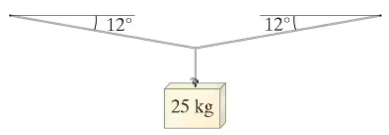
Problem 67When a mass of 25 kg is hung from the middle of a fixed straight aluminum wire, the wire sags to make an angle of 12° with the horizontal as shown in Fig. 12–90. Determine the radius of the wire.

Verified step by step guidance
Verified video answer for a similar problem:
Key Concepts
Tension in a Wire
Angles and Components of Forces
Geometry of the Wire
A steel rod of radius R = 15 cm and length ℓ₀ stands upright on a firm surface. A 78-kg man climbs atop the rod. When a metal is compressed, each atom throughout its bulk moves closer to its neighboring atom by exactly the same fractional amount. If iron atoms in steel are normally 2.0 x 10⁻¹⁰ m apart, by what distance did this interatomic spacing have to change in order to produce the normal force required to support the man? [Note: Neighboring atoms repel each other, and this repulsion accounts for the observed normal force.]
A pole projects horizontally from the front wall of a shop. A 6.1-kg sign hangs from the pole at a point 2.2 m from the wall (Fig. 12–88). If the pole is not to fall off, there must be another torque exerted to balance it. What exerts this torque? Use a diagram to show how this torque must act.
A 25-kg object is being lifted by two people pulling on the ends of a 1.15-mm-diameter nylon cord that goes over two 3.00-m-high poles that are 4.5 m apart, as shown in Fig. 12–93. How high above the floor will the object be when the cord breaks?
A pole projects horizontally from the front wall of a shop. A 6.1-kg sign hangs from the pole at a point 2.2 m from the wall (Fig. 12–88). Discuss whether compression, tension, and/or shear play a role in part (b).
A pole projects horizontally from the front wall of a shop. A 6.1-kg sign hangs from the pole at a point 2.2 m from the wall (Fig. 12–88). What is the torque due to this sign calculated about the point where the pole meets the wall?