
Ch 36: Special Relativity
Knight Calc - Physics for Scientists and Engineers 5th Edition
Knight Calc5th EditionPhysics for Scientists and EngineersISBN: 9780137344796Not the one you use?Change textbook
Chapter 36, Problem 51a

The star Delta goes supernova. One year later and 2.0 ly away, as measured by astronomers in the galaxy, star Epsilon explodes. Let the explosion of Delta be at xD = 0 and tD = 0. The explosions are observed by three spaceships cruising through the galaxy in the direction from Delta to Epsilon at velocities v1 = 0.30c, v2 = 0.50c, and v3 = 0.70c. All three spaceships, each at the origin of its reference frame, happen to pass Delta as it explodes. What are the times of the two explosions as measured by scientists on each of the three spaceships?

Verified step by step guidance
1
Define the problem in terms of the spacetime coordinates of the two events. The explosion of Delta occurs at (xD, tD) = (0, 0), and the explosion of Epsilon occurs at (xE, tE) = (2.0 ly, 1.0 yr) in the galaxy's rest frame.
Use the Lorentz transformation equations to calculate the time of each event in the reference frame of each spaceship. The Lorentz transformation for time is given by: t' = γ (t - (v x / c²)), where γ = 1 / √(1 - v² / c²) is the Lorentz factor, v is the velocity of the spaceship, x is the position of the event, and c is the speed of light.
For each spaceship, calculate the Lorentz factor γ using its velocity: v₁ = 0.30c, v₂ = 0.50c, and v₃ = 0.70c. Substitute these values into the formula for γ.
Substitute the coordinates of the Delta explosion (xD = 0, tD = 0) into the Lorentz transformation for time. Since xD = 0, the term v x / c² vanishes, and the transformed time for the Delta explosion is simply t' = 0 for all three spaceships.
Substitute the coordinates of the Epsilon explosion (xE = 2.0 ly, tE = 1.0 yr) into the Lorentz transformation for time for each spaceship. Use the calculated values of γ and the respective velocities v₁, v₂, and v₃ to find the transformed time t' for the Epsilon explosion in each spaceship's reference frame.

Verified video answer for a similar problem:

This video solution was recommended by our tutors as helpful for the problem above.
Was this helpful?

Key Concepts

Here are the essential concepts you must grasp in order to answer the question correctly.

Relativity of Simultaneity

The relativity of simultaneity is a fundamental concept in Einstein's theory of relativity, which states that events that are simultaneous in one reference frame may not be simultaneous in another. This is particularly important in scenarios involving high velocities, as the time experienced by observers moving at different speeds can vary significantly. In this question, the explosions of the stars are perceived differently by the observers in the spaceships due to their relative velocities.
Recommended video:
Guided course
04:27
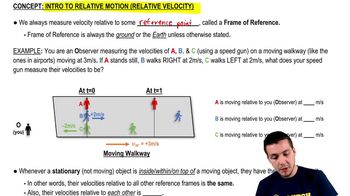
Intro to Relative Motion (Relative Velocity)

Lorentz Transformation

The Lorentz transformation equations relate the space and time coordinates of events as observed in different inertial frames moving at constant velocities relative to each other. These equations account for the effects of time dilation and length contraction, which are crucial for calculating the time of events as perceived by observers in different frames. In this scenario, the times of the explosions as measured by the spaceships can be determined using these transformations.
Recommended video:
Guided course
13:39
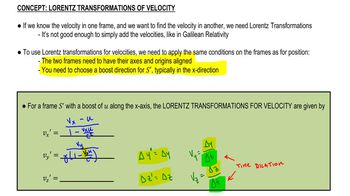
Lorentz Transformations of Velocity

Time Dilation

Time dilation is a phenomenon predicted by the theory of relativity, where time is measured to be moving slower for an observer in motion compared to a stationary observer. This effect becomes significant at speeds approaching the speed of light (c). In the context of the question, the spaceships traveling at different fractions of the speed of light will experience time differently, affecting their measurements of the explosions' timings.
Recommended video:
Guided course
12:57
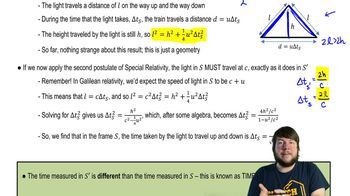
Time Dilation
Related Practice
Textbook Question

The quantity dE/dv, the rate of increase of energy with speed, is the amount of additional energy a moving object needs per 1 m/s increase in speed. A 25,000 kg rocket is traveling at 0.90c. How much additional energy is needed to increase its speed by 1 m/s?

1
views
Textbook Question

Two rockets approach each other. Each is traveling at 0.75c in the earth's reference frame. What is the speed, as a fraction of c, of one rocket relative to the other?

4
views
Textbook Question

The star Alpha goes supernova. Ten years later and 100 ly away, as measured by astronomers in the galaxy, star Beta explodes. An alien spacecraft passing through the galaxy finds that the distance between the two explosions is 120 ly. According to the aliens, what is the time between the explosions?

1
views
Textbook Question

A rocket traveling at 0.50c sets out for the nearest star, Alpha Centauri, which is 4.3 ly away from earth. It will return to earth immediately after reaching Alpha Centauri. What distance will the rocket travel and how long will the journey last according to (a) stay-at-home earthlings and (b) the rocket crew? (c) Which answers are the correct ones, those in part a or those in part b?

1
views
Textbook Question

The Stanford Linear Accelerator (SLAC) accelerates electrons to v = 0.99999997c in a 3.2-km-long tube. If they travel the length of the tube at full speed (they don’t, because they are accelerating), how long is the tube in the electrons’ reference frame?

1
views
Textbook Question

In an attempt to reduce the extraordinarily long travel times for voyaging to distant stars, some people have suggested traveling at close to the speed of light. Suppose you wish to visit the red giant star Betelgeuse, which is 430 ly away, and that you want your 20,000 kg rocket to move so fast that you age only 20 years during the round trip. How fast, as a fraction of c, must the rocket travel relative to earth?

1
views