
The quantity dE/dv, the rate of increase of energy with speed, is the amount of additional energy a moving object needs per 1 m/s increase in speed. A 25,000 kg rocket is traveling at 0.90c. How much additional energy is needed to increase its speed by 1 m/s?
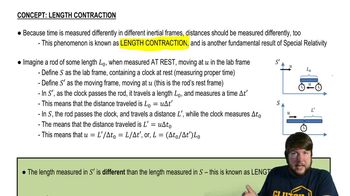
The Stanford Linear Accelerator (SLAC) accelerates electrons to v = 0.99999997c in a 3.2-km-long tube. If they travel the length of the tube at full speed (they don’t, because they are accelerating), how long is the tube in the electrons’ reference frame?
Verified step by step guidance
Verified video answer for a similar problem:
Key Concepts
Relativity of Length
Speed of Light
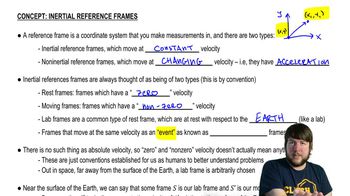
Reference Frames
The star Alpha goes supernova. Ten years later and 100 ly away, as measured by astronomers in the galaxy, star Beta explodes. An alien spacecraft passing through the galaxy finds that the distance between the two explosions is 120 ly. According to the aliens, what is the time between the explosions?
Two events in reference frame S occur 10 μs apart at the same point in space. The distance between the two events is 2400 m in reference frame S'. What is the velocity of S' relative to S?
In an attempt to reduce the extraordinarily long travel times for voyaging to distant stars, some people have suggested traveling at close to the speed of light. Suppose you wish to visit the red giant star Betelgeuse, which is 430 ly away, and that you want your 20,000 kg rocket to move so fast that you age only 20 years during the round trip. How fast, as a fraction of c, must the rocket travel relative to earth?
The star Delta goes supernova. One year later and 2.0 ly away, as measured by astronomers in the galaxy, star Epsilon explodes. Let the explosion of Delta be at xD = 0 and tD = 0. The explosions are observed by three spaceships cruising through the galaxy in the direction from Delta to Epsilon at velocities v1 = 0.30c, v2 = 0.50c, and v3 = 0.70c. All three spaceships, each at the origin of its reference frame, happen to pass Delta as it explodes. What are the times of the two explosions as measured by scientists on each of the three spaceships?
A modest supernova (the explosion of a massive star at the end of its life cycle) releases 1.5 x 10⁴⁴ J of energy in a few seconds. This is enough to outshine the entire galaxy in which it occurs. Suppose a star with the mass of our sun collides with an antimatter star of equal mass, causing complete annihilation. What is the ratio of the energy released in this star-antistar collision to the energy released in the supernova?
