Ch 01: Concepts of Motion
Knight Calc - Physics for Scientists and Engineers 5th Edition
Knight Calc5th EditionPhysics for Scientists and EngineersISBN: 9780137344796Not the one you use?Change textbook
Chapter 1, Problem 37

For Problems 34, 35, 36, 37, 38, 39, 40, 41, 42, and 43, draw a complete pictorial representation. Do not solve these problems or do any mathematics. A car starts from rest at a stop sign. It accelerates at 4.0 m/s² for 6.0 s, coasts for 2.0 s, and then slows at a rate of 2.5 m/s² for the next stop sign. How far apart are the stop signs?

Verified step by step guidance
1
Step 1: Begin by creating a pictorial representation of the problem. Draw a horizontal line to represent the car's motion along the road. Mark the initial stop sign as the starting point (Position A) and the final stop sign as the ending point (Position B).
Step 2: Divide the motion into three distinct segments: (1) acceleration phase, (2) coasting phase, and (3) deceleration phase. Label these segments clearly on the diagram.
Step 3: For the acceleration phase, indicate that the car starts from rest (initial velocity = 0 m/s) and accelerates at 4.0 m/s² for 6.0 seconds. Use arrows to show increasing velocity during this phase.
Step 4: For the coasting phase, show that the car maintains a constant velocity (no acceleration) for 2.0 seconds. Represent this with a straight horizontal arrow of constant length.
Step 5: For the deceleration phase, indicate that the car slows down at a rate of 2.5 m/s² until it comes to rest at the next stop sign. Use arrows to show decreasing velocity during this phase, ending at Position B.

Verified video answer for a similar problem:

This video solution was recommended by our tutors as helpful for the problem above.
Video duration:
3m
Was this helpful?

Key Concepts

Here are the essential concepts you must grasp in order to answer the question correctly.

Kinematics

Kinematics is the branch of mechanics that deals with the motion of objects without considering the forces that cause the motion. It involves concepts such as displacement, velocity, acceleration, and time. Understanding kinematics is essential for analyzing the motion of the car in the problem, as it describes how the car's position changes over time.
Recommended video:
Guided course
08:25
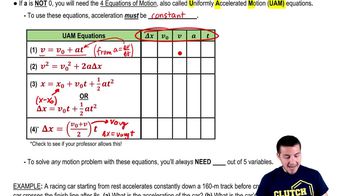
Kinematics Equations

Acceleration

Acceleration is the rate of change of velocity of an object with respect to time. It can be positive (speeding up) or negative (slowing down), and is measured in meters per second squared (m/s²). In this problem, the car experiences different accelerations during its motion, which are crucial for determining how far it travels between the stop signs.
Recommended video:
Guided course
05:47
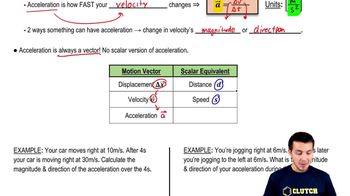
Intro to Acceleration

Displacement

Displacement is a vector quantity that refers to the change in position of an object. It is defined as the shortest distance from the initial to the final position, along with the direction. In the context of the problem, calculating the total displacement of the car as it accelerates, coasts, and decelerates is necessary to find the distance between the stop signs.
Recommended video:
Guided course
06:13
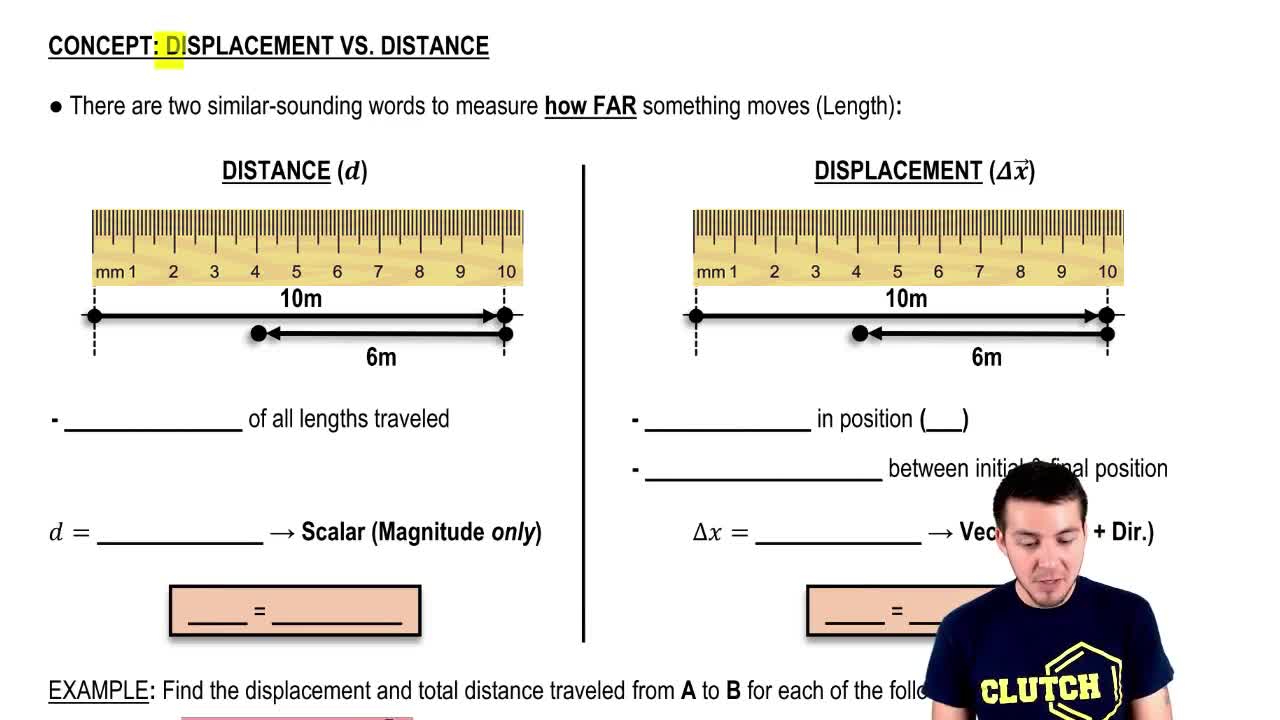
Displacement vs. Distance