Ch. 36 - The Special Theory of Relativity
Giancoli Douglas - Physics for Scientists and Engineers 5th edition
Giancoli Douglas5th editionPhysics for Scientists and EngineersISBN: 9780137488179Not the one you use?Change textbook
Chapter 35, Problem 62

A spaceship moving toward Earth at 0.65c transmits radio signals at 95.0 MHz. At what frequency should Earth receivers be tuned?

Verified step by step guidance
1
Identify the problem as a relativistic Doppler effect scenario, where the frequency of the signal received on Earth is affected by the relative motion of the spaceship and Earth.
Write the formula for the relativistic Doppler effect: fre=1+vc1-vcfe, where fr is the received frequency, fe is the emitted frequency, v is the relative velocity of the source (spaceship) with respect to the observer (Earth), and c is the speed of light.
Substitute the given values into the formula: fe=95.0 MHz, v=0.65c. The formula becomes: fr=1+0.651-0.6595.0.
Simplify the square root term: 1.650.35. This term represents the relativistic factor due to the motion of the spaceship.
Multiply the simplified relativistic factor by the emitted frequency 95.0 MHz to find the received frequency fr.

Verified video answer for a similar problem:

This video solution was recommended by our tutors as helpful for the problem above.
Video duration:
3m
Was this helpful?

Key Concepts

Here are the essential concepts you must grasp in order to answer the question correctly.

Doppler Effect

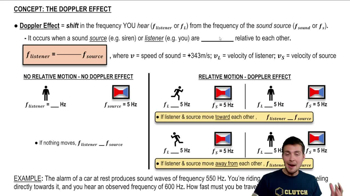
The Doppler Effect describes the change in frequency or wavelength of a wave in relation to an observer moving relative to the source of the wave. In this scenario, as the spaceship approaches Earth, the frequency of the transmitted radio signals will appear higher to the Earth receivers due to the relative motion, which is a key aspect of the effect.
Recommended video:
Guided course
07:40
The Doppler Effect

Relativistic Doppler Shift

The relativistic Doppler shift accounts for the effects of special relativity when dealing with objects moving at significant fractions of the speed of light. It modifies the classical Doppler effect equations to include time dilation, which is crucial for accurately calculating the observed frequency of signals from fast-moving sources like the spaceship.
Recommended video:
Guided course
07:40
The Doppler Effect

Frequency and Wavelength Relationship

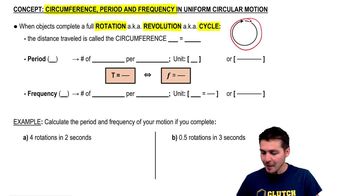
The relationship between frequency and wavelength is governed by the equation c = fλ, where c is the speed of light, f is the frequency, and λ is the wavelength. Understanding this relationship is essential for converting between frequency and wavelength when analyzing the signals received on Earth, especially when considering the effects of the Doppler shift.
Recommended video:
Guided course
05:08
Circumference, Period, and Frequency in UCM
Related Practice
Textbook Question

A certain galaxy has a Doppler shift given by ƒ₀ - ƒ = 0.1015 ƒ₀. Estimate how fast it is moving away from us.

1
views

Textbook Question

An atomic clock is taken to the North Pole, while another stays at the Equator. How far will they be out of synchronization after 1.5 years has elapsed? [Hint: Use the binomial expansion, Appendix A–2.]

Textbook Question

(III) (a) In reference frame S, a particle has momentum p=pxi\(\overrightarrow{\mathbf{p}\)}=p_{x}\(\mathbf{i}\) along the positive x axis. Show that in frame S’, which moves with speed v as in Fig. 36–12, the momentum has components

px=pxvE/c21v2/c2p_{x}^{\(\prime\)}=\(\frac{px-vE/c^2}{\sqrt{1-v^2/c^2}\)}

py=pyp_{y}^{\(\prime\)}=py

pz=pzp_{z}^{\(\prime\)}=pz

E=Epxv1v2/c2.E^{\(\prime\)}=\(\frac{E-p_{x}\)v}{\(\sqrt{1-v^2/c^2}\)}.

(These transformation equations hold, actually, for any direction of p\(\overrightarrow{\mathbf{p}\)}, as long as the motion of S' is along the x axis.) (b) Show that px, py, pz, E/c transform according to the Lorentz transformation in the same way as x, y, z, ct.

1
views
Textbook Question

A healthy astronaut’s heart rate is 60 beats/min . Flight doctors on Earth can monitor an astronaut’s vital signs remotely while in flight. How fast would an astronaut be flying away from Earth if the doctor measured her heart rate as 52 beats/min?

2
views
Textbook Question

An electron (m = 9.11 x 10⁻³¹ kg) is accelerated from rest to speed v by a conservative force. In this process, its potential energy decreases by 7.20 x 10⁻¹⁴ J . Determine the electron’s speed, v.

1
views
Textbook Question

Show that the kinetic energy K of a particle of mass m is related to its momentum p by the equation p=K2+2Kmc2cp=\(\frac{\sqrt{K^2+2Kmc^2}\)}{c}.

1
views