
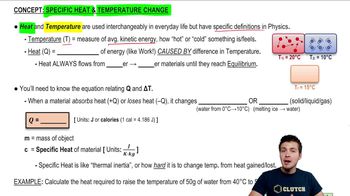
A laboratory technician drops a -kg sample of unknown solid material, at °C, into a calorimeter. The calorimeter can, initially at °C, is made of kg of copper and contains kg of water. The final temperature of the calorimeter can and contents is °C. Compute the specific heat of the sample.
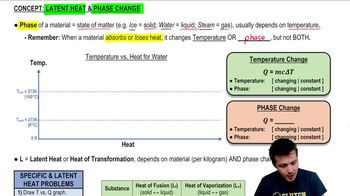
A vessel whose walls are thermally insulated contains kg of water and kg of ice, all at °C. The outlet of a tube leading from a boiler in which water is boiling at atmospheric pressure is inserted into the water. How many grams of steam must condense inside the vessel (also at atmospheric pressure) to raise the temperature of the system to °C? You can ignore the heat transferred to the container.
Verified step by step guidance
Verified video answer for a similar problem:
Key Concepts
Specific Heat Capacity
Latent Heat of Fusion and Vaporization
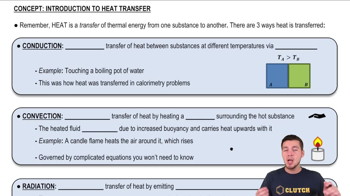
Heat Transfer and Energy Conservation
Suppose that the rod in Fig. a is made of copper, is cm long, and has a cross-sectional area of cm2 . Let °C and °C. What is the final steady-state temperature gradient along the rod?
A carpenter builds an exterior house wall with a layer of wood cm thick on the outside and a layer of Styrofoam insulation cm thick on the inside wall surface. The wood has , and the Styrofoam has . The interior surface temperature is °C, and the exterior surface temperature is °C. What is the temperature at the plane where the wood meets the Styrofoam?
A -kg silver ingot is taken from a furnace, where its temperature is °C, and placed on a large block of ice at °C. Assuming that all the heat given up by the silver is used to melt the ice, how much ice is melted?
Two rods, one made of brass and the other made of copper, are joined end to end. The length of the brass section is m and the length of the copper section is m. Each segment has cross-sectional area m2. The free end of the brass segment is in boiling water and the free end of the copper segment is in an ice–water mixture, in both cases under normal atmospheric pressure. The sides of the rods are insulated so there is no heat loss to the surroundings. What mass of ice is melted in min by the heat conducted by the composite rod?
An insulated beaker with negligible mass contains kg of water at °C. How many kilograms of ice at °C must be dropped into the water to make the final temperature of the system °C?
