Ch 26: Potential and Field
Knight Calc - Physics for Scientists and Engineers 5th Edition
Knight Calc5th EditionPhysics for Scientists and EngineersISBN: 9780137344796Not the one you use?Change textbook
Chapter 26, Problem 32

A 2.0-cm-diameter parallel-plate capacitor with a spacing of 0.50 mm is charged to 200 V. What are (a) the total energy stored in the electric field and (b) the energy density?

Verified step by step guidance
1
Step 1: Calculate the area of one plate of the capacitor. The diameter is given as 2.0 cm, so the radius is 1.0 cm (0.01 m). Use the formula for the area of a circle: A = πr².
Step 2: Determine the capacitance of the parallel-plate capacitor using the formula C = (ε₀A) / d, where ε₀ is the permittivity of free space (8.85 × 10⁻¹² F/m), A is the area of the plates, and d is the separation between the plates (0.50 mm = 0.0005 m).
Step 3: Calculate the total energy stored in the capacitor using the formula U = (1/2)CV², where C is the capacitance and V is the voltage (200 V).
Step 4: Compute the energy density (u), which is the energy per unit volume, using the formula u = U / Volume. The volume of the capacitor is given by the product of the area of the plates and the separation distance: Volume = A × d.
Step 5: Combine the results from the previous steps to express the total energy stored (U) and the energy density (u) in terms of the given values and constants.

Verified video answer for a similar problem:

This video solution was recommended by our tutors as helpful for the problem above.
Was this helpful?

Key Concepts

Here are the essential concepts you must grasp in order to answer the question correctly.

Capacitance

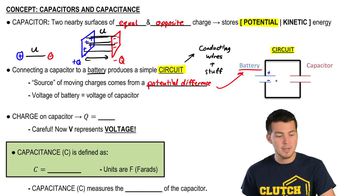
Capacitance is the ability of a capacitor to store charge per unit voltage. It is defined as C = Q/V, where C is capacitance, Q is the charge stored, and V is the voltage across the plates. For parallel-plate capacitors, capacitance can also be calculated using the formula C = ε₀(A/d), where ε₀ is the permittivity of free space, A is the area of the plates, and d is the separation between them.
Recommended video:
Guided course
08:02
Capacitors & Capacitance (Intro)

Energy Stored in a Capacitor

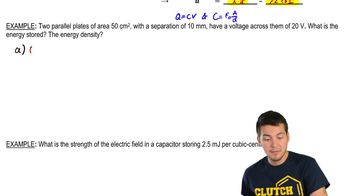
The energy (U) stored in a capacitor is given by the formula U = 1/2 CV², where C is the capacitance and V is the voltage. This equation shows that the energy stored is proportional to the square of the voltage and the capacitance. Understanding this relationship is crucial for calculating the total energy stored in the electric field of the capacitor.
Recommended video:
Guided course
09:26
Energy Stored by Capacitor

Energy Density

Energy density (u) in an electric field is defined as the energy stored per unit volume. For a capacitor, it can be calculated using the formula u = 1/2 εE², where ε is the permittivity of the material between the plates and E is the electric field strength. This concept helps in understanding how energy is distributed within the electric field of the capacitor.
Recommended video:
Guided course
8:13
Intro to Density