Ch 20: The Second Law of Thermodynamics
Young & Freedman Calc - University Physics 14th Edition
Young & Freedman Calc14th EditionUniversity PhysicsISBN: 9780321973610Not the one you use?Change textbook
Chapter 20, Problem 23a

A 15.015.0-kg block of ice at 0.00.0°C melts to liquid water at 0.00.0°C inside a large room at 20.020.0°C. Treat the ice and the room as an isolated system, and assume that the room is large enough for its temperature change to be ignored. Is the melting of the ice reversible or irreversible? Explain, using simple physical reasoning without resorting to any equations.

Verified step by step guidance
1
To determine if the melting of the ice is reversible or irreversible, we need to consider the concept of thermodynamic processes. A reversible process is one that can be reversed by an infinitesimal change in a variable, and both the system and surroundings can be returned to their original states without any net change.
In the case of the ice melting, the process involves a phase change from solid to liquid at a constant temperature of 0.0°C. This phase change requires the absorption of heat from the surroundings, which in this case is the room at 20.0°C.
For a process to be reversible, it must occur infinitely slowly, allowing the system to remain in thermal equilibrium with its surroundings at all times. However, the melting of ice in a room at a higher temperature is a spontaneous process driven by the temperature difference.
Since the room is at a higher temperature than the ice, heat flows spontaneously from the room to the ice, causing it to melt. This spontaneous heat flow due to a temperature gradient is characteristic of an irreversible process.
Therefore, the melting of the ice is an irreversible process because it involves a spontaneous transfer of heat from a warmer to a cooler body, and it cannot be reversed without external work or changes to the system.

Verified video answer for a similar problem:

This video solution was recommended by our tutors as helpful for the problem above.
Video duration:
2m
Was this helpful?

Key Concepts

Here are the essential concepts you must grasp in order to answer the question correctly.

Reversible and Irreversible Processes

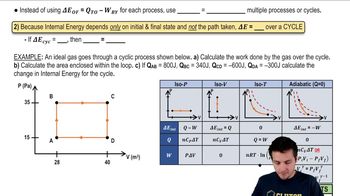
A reversible process is one that can be reversed without leaving any change in both the system and the surroundings. In contrast, an irreversible process results in a net change in the system or surroundings, often due to factors like friction, turbulence, or heat transfer across a finite temperature difference. Melting ice in a room at a higher temperature is typically irreversible because it involves heat transfer from the room to the ice, which cannot spontaneously reverse without external work.
Recommended video:
Guided course
08:45
Properties of Cyclic Thermodynamic Processes

Second Law of Thermodynamics

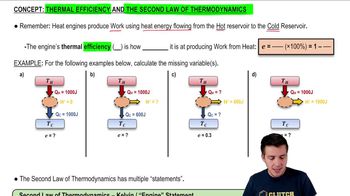
The second law of thermodynamics states that the total entropy of an isolated system can never decrease over time. It implies that natural processes tend to move towards a state of maximum entropy or disorder. In the context of melting ice, the process increases the entropy of the system (ice and room), as heat flows from the warmer room to the colder ice, making the process irreversible.
Recommended video:
Guided course
06:01
Thermal Efficiency & The Second Law of Thermodynamics

Entropy

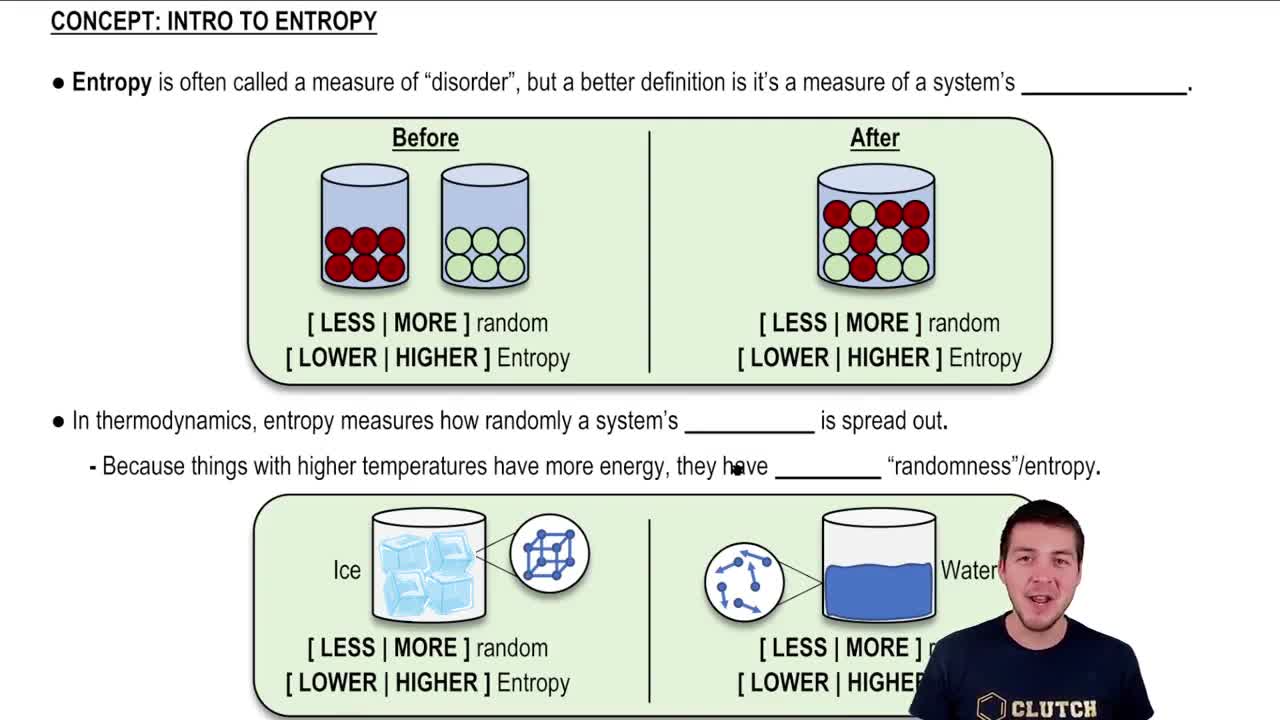
Entropy is a measure of the disorder or randomness in a system. When ice melts, the structured arrangement of water molecules in the solid state becomes more disordered in the liquid state, leading to an increase in entropy. This increase in entropy is a key indicator of the irreversibility of the melting process, as it aligns with the second law of thermodynamics, which dictates that entropy tends to increase in natural processes.
Recommended video:
Guided course
07:50
Intro to Entropy
Related Practice
Textbook Question

A sophomore with nothing better to do adds heat to 0.3500.350 kg of ice at 0.00.0°C until it is all melted. What is the change in entropy of the water?

1
views
Textbook Question

You decide to take a nice hot bath but discover that your thoughtless roommate has used up most of the hot water. You fill the tub with 195195 kg of 30.030.0°C water and attempt to warm it further by pouring in 5.005.00 kg of boiling water from the stove. Is this a reversible or an irreversible process? Use physical reasoning to explain.

1
views
Textbook Question

Two moles of an ideal gas occupy a volume VV. The gas expands isothermally and reversibly to a volume 3V3V. Is the velocity distribution changed by the isothermal expansion? Explain.

2
views
Textbook Question

You make tea with 0.2500.250 kg of 85.085.0°C water and let it cool to room temperature (20.020.0°C). Calculate the entropy change of the water while it cools.

1
views
Textbook Question

A 4.504.50-kg block of ice at 0.000.00°C falls into the ocean and melts. The average temperature of the ocean is 3.503.50°C, including all the deep water. By how much does the change of this ice to water at 3.503.50°C alter the entropy of the world? Does the entropy increase or decrease? (Hint: Do you think that the ocean temperature will change appreciably as the ice melts?)

1
views
Textbook Question

A box is separated by a partition into two parts of equal volume. The left side of the box contains 500500 molecules of nitrogen gas; the right side contains 100100 molecules of oxygen gas. The two gases are at the same temperature. The partition is punctured, and equilibrium is eventually attained. Assume that the volume of the box is large enough for each gas to undergo a free expansion and not change temperature. On average, how many molecules of each type will there be in either half of the box?

1
views