
Ch 20: The Micro/Macro Connection
Knight Calc - Physics for Scientists and Engineers 5th Edition
Knight Calc5th EditionPhysics for Scientists and EngineersISBN: 9780137344796Not the one you use?Change textbook
Chapter 20, Problem 68c

The rms speed of the molecules in 1.0 g of hydrogen gas is 1800 m/s. 500 J of work are done to compress the gas while, in the same process, 1200 J of heat energy are transferred from the gas to the environment. Afterward, what is the rms speed of the molecules?

Verified step by step guidance
1
Step 1: Understand the relationship between the root mean square (rms) speed of gas molecules and the temperature of the gas. The rms speed is given by the formula: 3kTm, where k is the Boltzmann constant, T is the temperature, and m is the mass of a single molecule.
Step 2: Recognize that the internal energy of the gas is directly proportional to its temperature. For a diatomic gas like hydrogen, the internal energy is given by 5nRT2, where n is the number of moles, R is the gas constant, and T is the temperature.
Step 3: Apply the first law of thermodynamics to determine the change in internal energy. The first law states: ΔU=Q-W, where ΔU is the change in internal energy, Q is the heat transferred, and W is the work done. Substitute Q = -1200 J (heat transferred out) and W = 500 J (work done on the gas) to find ΔU.
Step 4: Relate the change in internal energy to the change in temperature. Use the formula for internal energy of a diatomic gas: ΔU=5nRΔT2. Solve for ΔT using the value of ΔU calculated in Step 3.
Step 5: Calculate the new rms speed using the formula: 3kTm. Substitute the new temperature T (original temperature plus ΔT) and the mass of a hydrogen molecule to find the updated rms speed.

Verified video answer for a similar problem:

This video solution was recommended by our tutors as helpful for the problem above.
Video duration:
11m
Was this helpful?

Key Concepts

Here are the essential concepts you must grasp in order to answer the question correctly.

Root Mean Square (RMS) Speed

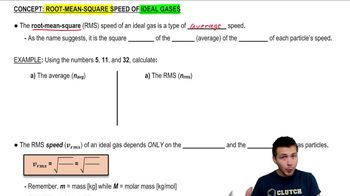
The root mean square speed is a measure of the average speed of particles in a gas, calculated as the square root of the average of the squares of the speeds of individual molecules. It is directly related to the temperature of the gas and is used in kinetic theory to describe the motion of gas particles.
Recommended video:
Guided course
05:21
Root-Mean-Square Speed of Ideal Gases

First Law of Thermodynamics

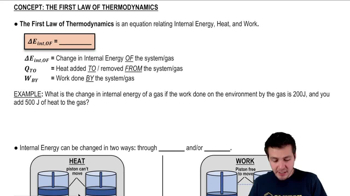
The First Law of Thermodynamics states that energy cannot be created or destroyed, only transformed from one form to another. In the context of gas compression, the work done on the gas and the heat transferred can be related to changes in internal energy, which affects the temperature and, consequently, the rms speed of the gas molecules.
Recommended video:
Guided course
08:04
The First Law of Thermodynamics

Kinetic Energy and Temperature Relationship

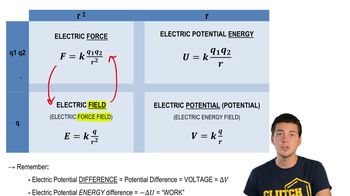
The kinetic energy of gas molecules is directly proportional to the temperature of the gas. As the temperature increases, the average kinetic energy of the molecules increases, which in turn raises the rms speed. This relationship is crucial for understanding how work and heat transfer affect the motion of gas particles.
Recommended video:
Guided course
03:43
Relationships Between Force, Field, Energy, Potential
Related Practice
Textbook Question

n moles of a diatomic gas with Cv = 5/2 R has initial pressure pi and volume Vi. The gas undergoes a process in which the pressure is directly proportional to the volume until the rms speed of the molecules has doubled. How much heat does this process require? Give your answer in terms of n, pi and Vi.

2
views
Textbook Question

The 2010 Nobel Prize in Physics was awarded for the discovery of graphene, a two-dimensional form of carbon in which the atoms form a two-dimensional crystal-lattice sheet only one atom thick. Predict the molar specific heat of graphene. Give your answer as a multiple of R.

Textbook Question

An experiment you're designing needs a gas with γ = 1.50. You recall from your physics class that no individual gas has this value, but it occurs to you that you could produce a gas with γ = 1.50 by mixing together a monatomic gas and a diatomic gas. What fraction of the molecules need to be monatomic?

2
views
Textbook Question

A monatomic gas is adiabatically compressed to 1/8 of its initial volume. Does each of the following quantities change? If so, does it increase or decrease, and by what factor? If not, why not? The thermal energy of the gas.

1
views
Textbook Question

A thin partition divides a container of volume V into two parts. One side contains nA moles of gas A in a fraction fA of the container; that is, VA = fAV. The other side contains nB moles of a different gas B at the same temperature in a fraction fB of the container. The partition is removed, allowing the gases to mix. Find an expression for the change of entropy. This is called the entropy of mixing.

Textbook Question

n1 moles of a monatomic gas and n2 moles of a diatomic gas are mixed together in a container. Derive an expression for the molar specific heat at constant volume of the mixture.

1
views