
Ch 20: The Micro/Macro Connection
Knight Calc - Physics for Scientists and Engineers 5th Edition
Knight Calc5th EditionPhysics for Scientists and EngineersISBN: 9780137344796Not the one you use?Change textbook
Chapter 20, Problem 66b

n moles of a diatomic gas with Cv = 5/2 R has initial pressure pi and volume Vi. The gas undergoes a process in which the pressure is directly proportional to the volume until the rms speed of the molecules has doubled. How much heat does this process require? Give your answer in terms of n, pi and Vi.

Verified step by step guidance
1
Step 1: Understand the relationship between pressure and volume. Since the problem states that pressure (P) is directly proportional to volume (V), we can write P = kV, where k is a proportionality constant. This relationship will help us express the pressure at any point during the process.
Step 2: Use the ideal gas law to relate pressure, volume, and temperature. The ideal gas law is given by PV = nRT. Substituting P = kV into the ideal gas law, we get kV^2 = nRT. This equation will allow us to find the temperature at any point during the process.
Step 3: Determine the final temperature. The root-mean-square (rms) speed of gas molecules is proportional to the square root of the temperature (v_rms ∝ √T). Since the rms speed doubles, the final temperature (Tf) must be four times the initial temperature (Ti). Using the initial state, Ti = (piVi) / (nR), so Tf = 4(piVi) / (nR).
Step 4: Calculate the work done during the process. The work done (W) in a process where P is proportional to V is given by W = ∫PdV = ∫kVdV. Substituting P = kV and integrating from the initial volume (Vi) to the final volume (Vf), we find W = (k/2)(Vf^2 - Vi^2). Use the relationship between P, V, and T to express Vf in terms of the given variables.
Step 5: Use the first law of thermodynamics to find the heat added. The first law states ΔQ = ΔU + W, where ΔQ is the heat added, ΔU is the change in internal energy, and W is the work done. For a diatomic gas, ΔU = nCvΔT, where Cv = (5/2)R. Substitute ΔT = Tf - Ti and the expression for W to find ΔQ in terms of n, pi, and Vi.

Key Concepts

Here are the essential concepts you must grasp in order to answer the question correctly.

Ideal Gas Law

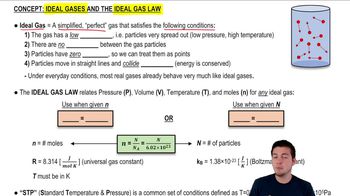
The Ideal Gas Law relates the pressure, volume, temperature, and number of moles of an ideal gas through the equation PV = nRT. This law is fundamental in understanding the behavior of gases under various conditions and is essential for analyzing processes involving changes in pressure and volume.
Recommended video:
Guided course
07:21
Ideal Gases and the Ideal Gas Law

Root Mean Square Speed

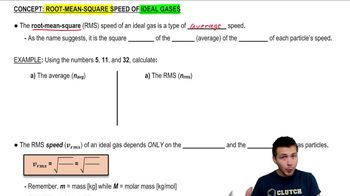
The root mean square (rms) speed of gas molecules is a measure of the average speed of particles in a gas, given by the formula v_rms = sqrt(3kT/m) or v_rms = sqrt(3RT/M). In this context, the problem states that the rms speed doubles, indicating a change in temperature and kinetic energy of the gas molecules, which affects the heat transfer during the process.
Recommended video:
Guided course
05:21
Root-Mean-Square Speed of Ideal Gases

Heat Transfer in Thermodynamic Processes

Heat transfer in thermodynamic processes can be calculated using the first law of thermodynamics, which states that the change in internal energy is equal to the heat added to the system minus the work done by the system. In this case, understanding how the pressure-volume relationship affects the heat required for the process is crucial for solving the problem.
Recommended video:
Guided course
05:14
Overview of Heat Transfer
Related Practice
Textbook Question

A water molecule has its three atoms arranged in a 'V' shape, so it has rotational kinetic energy around any of three mutually perpendicular axes. However, like diatomic molecules, its vibrational modes are not active at temperatures below 1000 K. What is the thermal energy of 2.0 mol of steam at a temperature of 160°C?

1
views
Textbook Question

A monatomic gas is adiabatically compressed to 1/8 of its initial volume. Does each of the following quantities change? If so, does it increase or decrease, and by what factor? If not, why not? The mean free path.

1
views
Textbook Question

The rms speed of the molecules in 1.0 g of hydrogen gas is 1800 m/s. 500 J of work are done to compress the gas while, in the same process, 1200 J of heat energy are transferred from the gas to the environment. Afterward, what is the rms speed of the molecules?

2
views
Textbook Question

The 2010 Nobel Prize in Physics was awarded for the discovery of graphene, a two-dimensional form of carbon in which the atoms form a two-dimensional crystal-lattice sheet only one atom thick. Predict the molar specific heat of graphene. Give your answer as a multiple of R.

Textbook Question

A monatomic gas is adiabatically compressed to 1/8 of its initial volume. Does each of the following quantities change? If so, does it increase or decrease, and by what factor? If not, why not? The thermal energy of the gas.

1
views
Textbook Question

n1 moles of a monatomic gas and n2 moles of a diatomic gas are mixed together in a container. Derive an expression for the molar specific heat at constant volume of the mixture.

1
views