Ch 06: Work & Kinetic Energy
Young & Freedman Calc - University Physics 14th Edition
Young & Freedman Calc14th EditionUniversity PhysicsISBN: 9780321973610Not the one you use?Change textbook
Chapter 6, Problem 33a

A surgeon is using material from a donated heart to repair a patient's damaged aorta and needs to know the elastic characteristics of this aortal material. Tests performed on a 16.016.0-cm strip of the donated aorta reveal that it stretches 3.753.75 cm when a 1.501.50-N pull is exerted on it. What is the force constant of this strip of aortal material?

Verified step by step guidance
1
Step 1: Understand the problem. The force constant (k) is a measure of the stiffness of the material and is defined by Hooke's Law: \( F = k \Delta x \), where \( F \) is the applied force, \( \Delta x \) is the extension, and \( k \) is the force constant. We need to calculate \( k \) using the given values.
Step 2: Identify the given values. The applied force \( F \) is 1.50 N, the original length of the strip is 16.0 cm, and the extension \( \Delta x \) is 3.75 cm. Note that \( \Delta x \) is the change in length, not the total length.
Step 3: Convert units if necessary. Since the force constant \( k \) is typically expressed in \( \text{N/m} \), convert the extension \( \Delta x \) from centimeters to meters. Use the conversion factor: \( 1 \, \text{cm} = 0.01 \, \text{m} \). Thus, \( \Delta x = 3.75 \, \text{cm} \times 0.01 \, \text{m/cm} = 0.0375 \, \text{m} \).
Step 4: Rearrange Hooke's Law to solve for \( k \). The formula becomes \( k = \frac{F}{\Delta x} \). Substitute the values of \( F \) and \( \Delta x \) into the equation.
Step 5: Perform the calculation. Divide the force \( F \) (1.50 N) by the extension \( \Delta x \) (0.0375 m) to find the force constant \( k \). The result will be in \( \text{N/m} \).

Verified video answer for a similar problem:

This video solution was recommended by our tutors as helpful for the problem above.
Video duration:
3m
Was this helpful?

Key Concepts

Here are the essential concepts you must grasp in order to answer the question correctly.

Hooke's Law

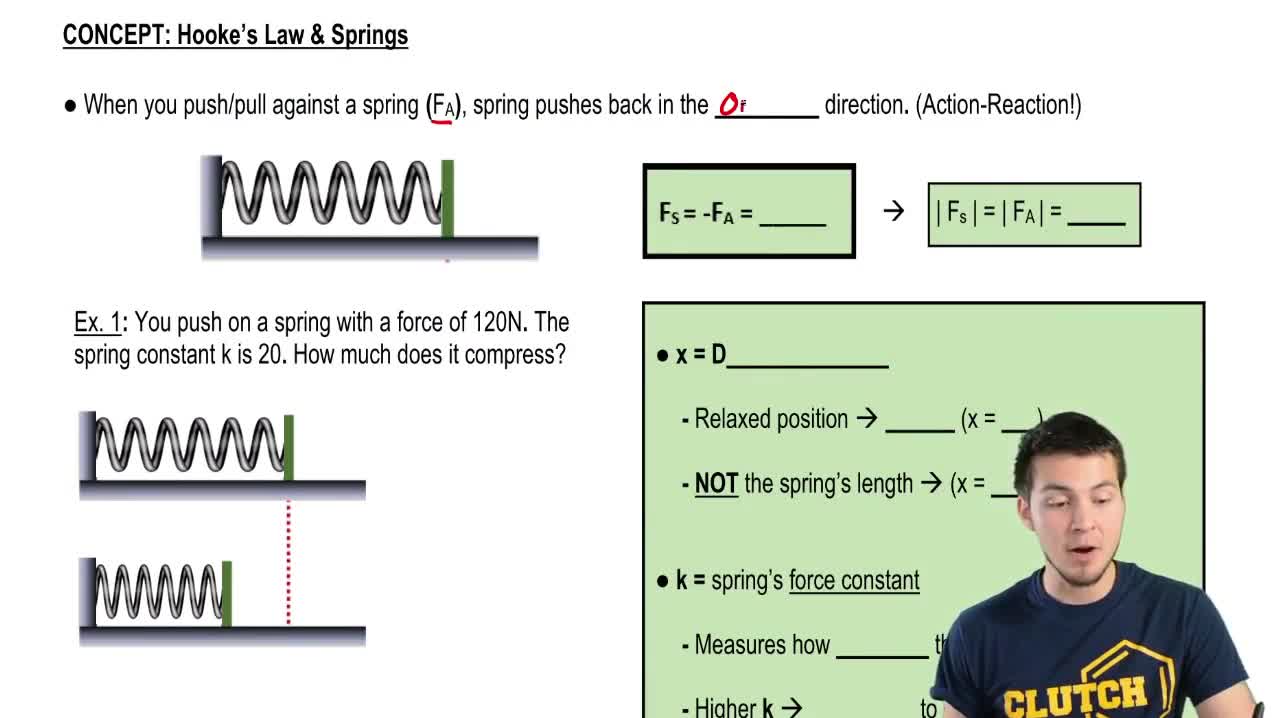
Hooke's Law states that the force exerted by a spring (or elastic material) is directly proportional to the amount it is stretched or compressed, as long as the elastic limit is not exceeded. Mathematically, it is expressed as F = kx, where F is the force applied, k is the spring constant (or force constant), and x is the displacement from the equilibrium position. This principle is fundamental in understanding how materials deform under stress.
Recommended video:
Guided course
05:27
Spring Force (Hooke's Law)

Elasticity

Elasticity is the property of a material that enables it to return to its original shape after being deformed by an external force. It is quantified by the material's elastic modulus, which measures the stiffness of the material. In the context of the aorta, understanding its elasticity is crucial for determining how it will behave under physiological conditions and how it can withstand the forces exerted by blood flow.
Recommended video:
Guided course
08:56
Intro To Elastic Collisions

Force Constant

The force constant, often denoted as k, is a measure of the stiffness of an elastic material. It is defined as the ratio of the force applied to the displacement produced, as described by Hooke's Law. A higher force constant indicates a stiffer material that requires more force to achieve the same amount of stretch, which is particularly important in medical applications where material properties can affect the success of surgical repairs.
Recommended video:
Guided course
08:59
Phase Constant of a Wave Function
Related Practice
Textbook Question

A 6.06.0-kg box moving at 3.03.0 m/s on a horizontal, frictionless surface runs into a light spring of force constant 7575 N/cm. Use the work–energy theorem to find the maximum compression of the spring.

1
views
Textbook Question

You throw a 3.003.00-N rock vertically into the air from ground level. You observe that when it is 15.015.0 m above the ground, it is traveling at 25.025.0 m/s upward. Use the work–energy theorem to find its maximum height.

7
views
Textbook Question

A surgeon is using material from a donated heart to repair a patient's damaged aorta and needs to know the elastic characteristics of this aortal material. Tests performed on a 16.016.0-cm strip of the donated aorta reveal that it stretches 3.753.75 cm when a 1.501.50-N pull is exerted on it. If the maximum distance it will be able to stretch when it replaces the aorta in the damaged heart is 1.141.14 cm, what is the greatest force it will be able to exert there?

3
views
Textbook Question

A 20.020.0-kg rock is sliding on a rough, horizontal surface at 8.008.00 m/s and eventually stops due to friction. The coefficient of kinetic friction between the rock and the surface is 0.2000.200. What average power is produced by friction as the rock stops?

6
views
Textbook Question

You throw a 3.003.00-N rock vertically into the air from ground level. You observe that when it is 15.015.0 m above the ground, it is traveling at 25.025.0 m/s upward. Use the work–energy theorem to find the rock's speed just as it left the ground.

2
views
Textbook Question

Is it reasonable that a 3030-kg child could run fast enough to have 100100 J of kinetic energy?

7
views