
Textbook Question
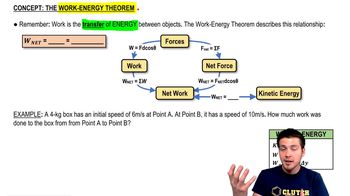
A -kg box moving at m/s on a horizontal, frictionless surface runs into a light spring of force constant N/cm. Use the work–energy theorem to find the maximum compression of the spring.
1
views

 Verified step by step guidance
 04:10
04:10
 06:07
06:07 07:24
07:24A -kg box moving at m/s on a horizontal, frictionless surface runs into a light spring of force constant N/cm. Use the work–energy theorem to find the maximum compression of the spring.
A -kg book is sliding along a rough horizontal surface. At point it is moving at m/s, and at point it has slowed to m/s. How much work was done on the book between and ?
A surgeon is using material from a donated heart to repair a patient's damaged aorta and needs to know the elastic characteristics of this aortal material. Tests performed on a -cm strip of the donated aorta reveal that it stretches cm when a -N pull is exerted on it. What is the force constant of this strip of aortal material?
A surgeon is using material from a donated heart to repair a patient's damaged aorta and needs to know the elastic characteristics of this aortal material. Tests performed on a -cm strip of the donated aorta reveal that it stretches cm when a -N pull is exerted on it. If the maximum distance it will be able to stretch when it replaces the aorta in the damaged heart is cm, what is the greatest force it will be able to exert there?
You throw a -N rock vertically into the air from ground level. You observe that when it is m above the ground, it is traveling at m/s upward. Use the work–energy theorem to find the rock's speed just as it left the ground.
Is it reasonable that a -kg child could run fast enough to have J of kinetic energy?