Ch 02: Motion Along a Straight Line
Young & Freedman Calc - University Physics 14th Edition
Young & Freedman Calc14th EditionUniversity PhysicsISBN: 9780321973610Not the one you use?Change textbook
Chapter 2, Problem 30a

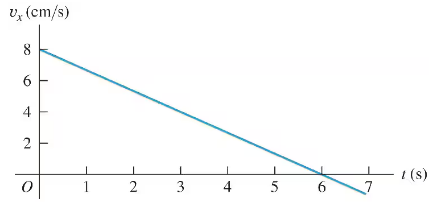
A cat walks in a straight line, which we shall call the xx-axis, with the positive direction to the right. As an observant physicist, you make measurements of this cat's motion and construct a graph of the feline's velocity as a function of time (Fig. E2.302.30). Find the cat's velocity at t=4.0t = 4.0 s and at t=7.0t = 7.0 s.
Velocity-time graph showing a linear decrease from 8 cm/s at 0s to 0 cm/s at 6s, continuing to -2 cm/s at 7s.

Verified step by step guidance
1
Examine the first graph, which shows the velocity of the cat in meters per second (m/s) as a function of time in seconds (s). The velocity is represented by the red line.
To find the velocity at t = 4.0 s, locate 4.0 s on the horizontal time axis and move vertically to intersect the red line. Read the corresponding velocity value on the vertical axis.
Similarly, to find the velocity at t = 7.0 s, locate 7.0 s on the horizontal time axis and move vertically to intersect the red line. Read the corresponding velocity value on the vertical axis.
The second graph is not relevant to the problem as it is in different units (cm/s) and does not match the description of the problem. Focus on the first graph for the solution.
Ensure that the values read from the graph are interpreted correctly, considering the scale and units provided on the axes.

Verified video answer for a similar problem:

This video solution was recommended by our tutors as helpful for the problem above.
Video duration:
2m
Was this helpful?

Key Concepts

Here are the essential concepts you must grasp in order to answer the question correctly.

Velocity

Velocity is a vector quantity that describes the rate of change of an object's position with respect to time. It has both magnitude and direction, indicating how fast an object is moving and in which direction. In this context, the cat's velocity is measured in centimeters per second (cm/s) along the x-axis.
Recommended video:
Guided course
7:27
Escape Velocity

Velocity-Time Graph

A velocity-time graph visually represents an object's velocity as a function of time. The slope of the graph indicates acceleration, while the area under the curve represents displacement. In the provided graph, the linear decrease in velocity suggests that the cat is decelerating until it reaches a negative velocity, indicating a change in direction.
Recommended video:
Guided course
05:59
Velocity-Time Graphs & Acceleration

Linear Motion

Linear motion refers to the movement of an object along a straight path. In this scenario, the cat's motion is described as linear along the x-axis, with its velocity changing uniformly over time. Understanding linear motion is essential for analyzing the cat's velocity at specific time intervals, such as at 4.0 seconds and 7.0 seconds.
Recommended video:
Guided course
07:06
Angular Momentum of Objects in Linear Motion
Related Practice
Textbook Question

A car sits on an entrance ramp to a freeway, waiting for a break in the traffic. Then the driver accelerates with constant acceleration along the ramp and onto the freeway. The car starts from rest, moves in a straight line, and has a speed of 2020 m/s (4545 mi/h) when it reaches the end of the 120120-m-long ramp. How much time does it take the car to travel the length of the ramp?

10
views
Textbook Question

A cat walks in a straight line, which we shall call the xx-axis, with the positive direction to the right. As an observant physicist, you make measurements of this cat's motion and construct a graph of the feline's velocity as a function of time (Fig. E2.302.30). What distance does the cat move during the first 4.54.5 s? From t=0 t = 0 to t=7.5t = 7.5 s?

4
views
Textbook Question

A car sits on an entrance ramp to a freeway, waiting for a break in the traffic. Then the driver accelerates with constant acceleration along the ramp and onto the freeway. The car starts from rest, moves in a straight line, and has a speed of 2020 m/s (4545 mi/h) when it reaches the end of the 120120-m-long ramp. What is the acceleration of the car?

7
views
Textbook Question

A cat walks in a straight line, which we shall call the xx-axis, with the positive direction to the right. As an observant physicist, you make measurements of this cat's motion and construct a graph of the feline's velocity as a function of time (Fig. E2.302.30). What is the cat's acceleration at t=3.0t = 3.0 s? At t=6.0t = 6.0 s? At t=7.0t = 7.0 s?

5
views
Textbook Question

A cat walks in a straight line, which we shall call the xx-axis, with the positive direction to the right. As an observant physicist, you make measurements of this cat's motion and construct a graph of the feline's velocity as a function of time (Fig. E2.302.30). Assuming that the cat started at the origin, sketch clear graphs of the cat's acceleration and position as functions of time.

13
views
Textbook Question

At launch a rocket ship weighs 4.54.5 million pounds. When it is launched from rest, it takes 8.008.00 s to reach 161161 km/h; at the end of the first 1.001.00 min, its speed is 16101610 km/h. What is the average acceleration (in m/s2) of the rocket (i) during the first 8.008.00 s and (ii) between 8.008.00 s and the end of the first 1.001.00 min?

2
views