
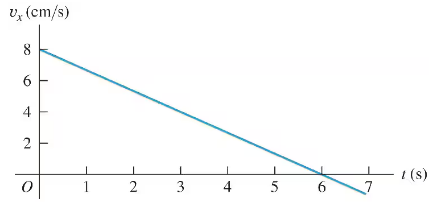
A cat walks in a straight line, which we shall call the -axis, with the positive direction to the right. As an observant physicist, you make measurements of this cat's motion and construct a graph of the feline's velocity as a function of time (Fig. E). What is the cat's acceleration at s? At s? At s?
A cat walks in a straight line, which we shall call the -axis, with the positive direction to the right. As an observant physicist, you make measurements of this cat's motion and construct a graph of the feline's velocity as a function of time (Fig. E). What distance does the cat move during the first s? From to s?

Verified step by step guidance
Verified video answer for a similar problem:
Key Concepts
Velocity
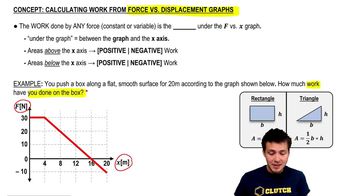
Area under the Velocity-Time Graph
Linear Motion
A cat walks in a straight line, which we shall call the -axis, with the positive direction to the right. As an observant physicist, you make measurements of this cat's motion and construct a graph of the feline's velocity as a function of time (Fig. E). Find the cat's velocity at s and at s.
A small block has constant acceleration as it slides down a frictionless incline. The block is released from rest at the top of the incline, and its speed after it has traveled m to the bottom of the incline is m/s. What is the speed of the block when it is m from the top of the incline?
A cat walks in a straight line, which we shall call the -axis, with the positive direction to the right. As an observant physicist, you make measurements of this cat's motion and construct a graph of the feline's velocity as a function of time (Fig. E). Assuming that the cat started at the origin, sketch clear graphs of the cat's acceleration and position as functions of time.
At launch a rocket ship weighs million pounds. When it is launched from rest, it takes s to reach km/h; at the end of the first min, its speed is km/h. What is the average acceleration (in m/s2) of the rocket (i) during the first s and (ii) between s and the end of the first min?
At the instant the traffic light turns green, a car that has been waiting at an intersection starts ahead with a constant acceleration of m/s2. At the same instant a truck, traveling with a constant speed of m/s, overtakes and passes the car. How far beyond its starting point does the car overtake the truck?
