
Ch. 12 - Static Equilibrium; Elasticity and Fracture
Giancoli Douglas - Physics for Scientists and Engineers 5th edition
Giancoli Douglas5th editionPhysics for Scientists and EngineersISBN: 9780137488179Not the one you use?Change textbook
Chapter 12, Problem 95e

Suppose a 65-kg person jumps from a height of 3.0 m down to the ground. Estimate the stress and determine if the tibia will break in a stiff-legged landing (d = 1.0 cm).
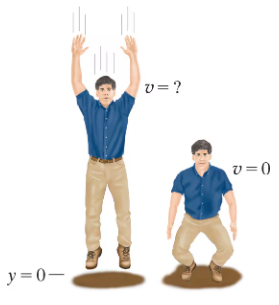
Illustration of a person jumping with arms raised and landing in a crouched position, showing different velocities.

Verified step by step guidance
1
Determine the force exerted on the tibia during the landing. Start by calculating the velocity just before impact using the equation for free fall: 2gh, where g is the acceleration due to gravity (9.8 m/s²) and h is the height (3.0 m).
Estimate the deceleration during the landing. Assume the stopping distance (compression of the tibia) is approximately equal to the diameter of the tibia, d = 1.0 cm = 0.01 m. Use the kinematic equation v2 = 2ad to solve for the deceleration a.
Calculate the force exerted on the tibia using Newton's second law: F = ma, where m is the mass of the person (65 kg) and a is the deceleration calculated in the previous step.
Determine the stress on the tibia. Stress is defined as force per unit area: σ = F/A. The cross-sectional area of the tibia can be approximated as a circle with diameter d = 1.0 cm, so A = π(d/2)2.
Compare the calculated stress to the breaking stress of the tibia (approximately 1.6 × 10⁸ N/m²). If the calculated stress exceeds this value, the tibia will break; otherwise, it will not.

Verified video answer for a similar problem:

This video solution was recommended by our tutors as helpful for the problem above.
Video duration:
6m
Was this helpful?

Key Concepts

Here are the essential concepts you must grasp in order to answer the question correctly.

Potential Energy

Potential energy is the energy stored in an object due to its position in a gravitational field. For a person jumping from a height, this energy can be calculated using the formula PE = mgh, where m is mass, g is the acceleration due to gravity, and h is the height. As the person falls, this potential energy is converted into kinetic energy, which is crucial for understanding the forces involved upon landing.
Recommended video:
Guided course
07:24
Potential Energy Graphs

Impact Force

Impact force is the force exerted by an object when it comes to a sudden stop after falling. It can be estimated using the impulse-momentum theorem, which relates the change in momentum to the force applied over the time of impact. In a stiff-legged landing, the impact force is concentrated over a short distance, leading to higher stress on the bones, which is essential for assessing the risk of injury.
Recommended video:
Guided course
06:48
Intro to Centripetal Forces

Stress and Strain

Stress is defined as the force applied per unit area within materials, while strain is the deformation that occurs as a result of that stress. In the context of the tibia during a landing, calculating the stress involves determining the impact force and the cross-sectional area of the bone. Understanding these concepts helps in evaluating whether the stress exceeds the bone's strength, which could lead to a fracture.
Recommended video:
07:49
Ray Diagrams for Convex Mirrors