
Sound is detected when a sound wave causes the tympanic membrane (the eardrum) to vibrate. Typically, the diameter of this membrane is about 8.4 mm in humans. How much energy is delivered to the eardrum each second when someone whispers (20 dB) a secret in your ear?
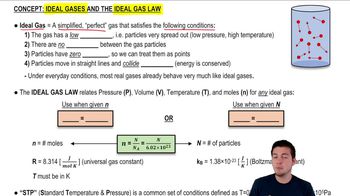
An oscillator vibrating at 1250 Hz produces a sound wave that travels through an ideal gas at 325 m/s when the gas temperature is 22.0°C. For a certain experiment, you need to have the same oscillator produce sound of wavelength 28.5 cm in this gas. What should the gas temperature be to achieve this wavelength?
Verified step by step guidance
Verified video answer for a similar problem:
Key Concepts
Wave Speed Equation
Ideal Gas Law
Temperature and Sound Speed
(a) By what factor must the sound intensity be increased to raise the sound intensity level by 13.0 dB? (b) Explain why you don't need to know the original sound intensity
Consider a sound wave in air that has displacement amplitude 0.0200 mm. Calculate the pressure amplitude for frequencies of (a) 150 Hz; (b) 1500 Hz; (c) 15,000 Hz. In each case compare the result to the pain threshold, which is 30 Pa.
A loud factory machine produces sound having a displacement amplitude of 1.00 mm, but the frequency of this sound can be adjusted. In order to prevent ear damage to the workers, the maximum pressure amplitude of the sound waves is limited to 10.0 Pa. Under the conditions of this factory, the bulk modulus of air is 1.42 × 10⁵ Pa. What is the highest-frequency sound to which this machine can be adjusted without exceeding the prescribed limit? Is this frequency audible to the workers?
A metal bar with a length of 1.50 m has density 6400 kg/m3. Longitudinal sound waves take 3.90 × 10⁻⁴ s to travel from one end of the bar to the other. What is Young's modulus for this metal?
What must be the stress (F/A) in a stretched wire of a material whose Young's modulus is Y for the speed of longitudinal waves to equal 30 times the speed of transverse waves?
