Ch 06: Dynamics I: Motion Along a Line
Knight Calc - Physics for Scientists and Engineers 5th Edition
Knight Calc5th EditionPhysics for Scientists and EngineersISBN: 9780137344796Not the one you use?Change textbook
Chapter 6, Problem 62

A 500 g ball moves horizontally with velocity v๐“ = ( 15 m) / (t + 1 s) for t > 0 s. What is the net force on the ball at t = 1 s?

Verified step by step guidance
1
Step 1: Identify the given quantities. The mass of the ball is m = 500 g = 0.5 kg (convert grams to kilograms). The velocity of the ball is given as vโ‚“ = (15 m) / (t + 1 s). We are tasked with finding the net force on the ball at t = 1 s.
Step 2: Recall Newton's Second Law of Motion, which states that the net force on an object is given by F = m * a, where F is the net force, m is the mass, and a is the acceleration. To find the force, we first need to calculate the acceleration of the ball at t = 1 s.
Step 3: Acceleration is the time derivative of velocity. Differentiate the velocity function vโ‚“ = (15 m) / (t + 1 s) with respect to time t. Use the quotient rule for differentiation: d(vโ‚“)/dt = d/dt[(15)/(t + 1)] = -15 / (t + 1)ยฒ.
Step 4: Substitute t = 1 s into the expression for acceleration to find the acceleration at that specific time. The acceleration at t = 1 s is a = -15 / (1 + 1)ยฒ = -15 / 4 m/sยฒ.
Step 5: Use the formula F = m * a to calculate the net force. Substitute m = 0.5 kg and a = -15 / 4 m/sยฒ into the equation. The net force is F = 0.5 * (-15 / 4) N. Simplify this expression to find the magnitude and direction of the net force.

Verified video answer for a similar problem:

This video solution was recommended by our tutors as helpful for the problem above.
Video duration:
6m
Was this helpful?

Key Concepts

Here are the essential concepts you must grasp in order to answer the question correctly.

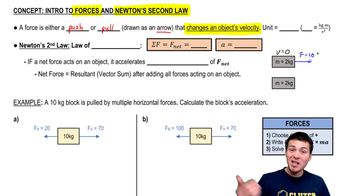
Newton's Second Law of Motion

Newton's Second Law states that the net force acting on an object is equal to the mass of the object multiplied by its acceleration (F = ma). This principle is crucial for determining the net force on the ball, as it relates the force to the object's mass and how its velocity changes over time.
Recommended video:
Guided course
06:54
Intro to Forces & Newton's Second Law

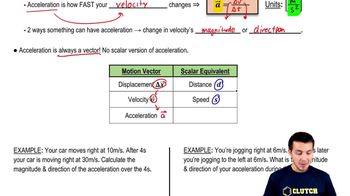
Acceleration

Acceleration is defined as the rate of change of velocity with respect to time. In this scenario, the velocity of the ball is given as a function of time, which means we need to differentiate this function to find the acceleration at a specific time, such as t = 1 s.
Recommended video:
Guided course
05:47
Intro to Acceleration

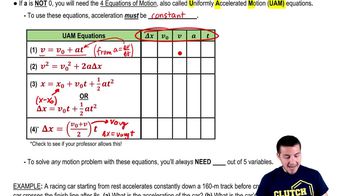
Kinematics

Kinematics is the branch of mechanics that describes the motion of objects without considering the forces that cause the motion. Understanding kinematics is essential here, as it allows us to analyze the ball's velocity function and derive the necessary information about its motion to calculate the net force.
Recommended video:
Guided course
08:25
Kinematics Equations
Related Practice
Textbook Question

The 2.0 kg wood box in FIGURE P6.58 slides down a vertical wood wall while you push on it at a 45ยฐ angle. What magnitude of force should you apply to cause the box to slide down at a constant speed?

5
views

Textbook Question

Astronauts in space 'weigh' themselves by oscillating on a spring. Suppose the position of an oscillating 75 kg astronaut is given by x=(0.30m)sin((ฯ€rad/s)ร—t)x = (0.30 \, \(\text{m}\)) \(\sin\)((\(\pi\) \, \(\text{rad/s}\)) \(\times\) t), where t is in s. What force does the spring exert on the astronaut at (a) t = 1.0 s and (b) 1.5 s? Note that the angle of the sine function is in radians.

2
views
Textbook Question

A ball is shot from a compressed-air gun at twice its terminal speed. What is the ball's initial acceleration, as a multiple of g, if it is shot straight up?

1
views
Textbook Question

What is the magnitude of the acceleration of a skydiver at the instant she is falling at one-half her terminal speed?

2
views
Textbook Question

A particle of mass m moving along the x-axis experiences the net force Fโ‚“ = ct, where c is a constant. The particle has velocity vโ‚€โ‚“ at t = 0. Find an algebraic expression for the particle's velocity vโ‚“ at a later time t.

2
views
Textbook Question

A block of mass m is at rest at the origin at t = 0. It is pushed with constant force Fโ‚€ from ๐“ = 0 to ๐“ = L across a horizontal surface whose coefficient of kinetic friction is ฮผโ‚– = ฮผโ‚€ ( 1 - ๐“/L ) . That is, the coefficient of friction decreases from ฮผโ‚€ at ๐“ = 0 to zero at ๐“ = L. b. Find an expression for the block's speed as it reaches position L.