
Ch 06: Dynamics I: Motion Along a Line
Knight Calc - Physics for Scientists and Engineers 5th Edition
Knight Calc5th EditionPhysics for Scientists and EngineersISBN: 9780137344796Not the one you use?Change textbook
Chapter 6, Problem 58

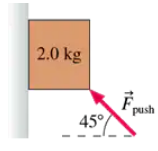
The 2.0 kg wood box in FIGURE P6.58 slides down a vertical wood wall while you push on it at a 45° angle. What magnitude of force should you apply to cause the box to slide down at a constant speed?

Verified step by step guidance
1
Identify the forces acting on the box: (1) the gravitational force \( F_g = m \cdot g \), where \( m = 2.0 \ \text{kg} \) and \( g = 9.8 \ \text{m/s}^2 \), (2) the normal force \( F_N \) due to your applied force, (3) the frictional force \( F_f \), and (4) the applied force \( F_{app} \) at a 45° angle.
Break the applied force \( F_{app} \) into components: (1) the horizontal component \( F_{app,x} = F_{app} \cdot \cos(45°) \), which contributes to the normal force, and (2) the vertical component \( F_{app,y} = F_{app} \cdot \sin(45°) \), which opposes the gravitational force.
Write the condition for constant speed: Since the box slides at a constant speed, the net force in both the vertical and horizontal directions must be zero. This means the downward force (gravity) is balanced by the upward forces (friction and the vertical component of the applied force).
Express the frictional force: The frictional force is given by \( F_f = \mu \cdot F_N \), where \( \mu \) is the coefficient of kinetic friction for wood on wood (typically \( \mu \approx 0.2 \)), and \( F_N \) is the normal force. The normal force is equal to the horizontal component of the applied force, \( F_N = F_{app,x} = F_{app} \cdot \cos(45°) \).
Set up the force balance equations: (1) In the vertical direction, \( F_g = F_f + F_{app,y} \), or \( m \cdot g = \mu \cdot (F_{app} \cdot \cos(45°)) + F_{app} \cdot \sin(45°) \). Solve this equation for \( F_{app} \) to find the magnitude of the applied force needed to maintain constant speed.

Verified video answer for a similar problem:

This video solution was recommended by our tutors as helpful for the problem above.
Video duration:
5m
Was this helpful?

Key Concepts

Here are the essential concepts you must grasp in order to answer the question correctly.

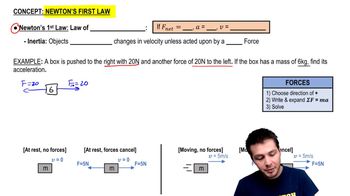
Newton's First Law of Motion

Newton's First Law states that an object at rest will remain at rest, and an object in motion will continue in motion at a constant velocity unless acted upon by a net external force. In this scenario, for the box to slide down at a constant speed, the net force acting on it must be zero, meaning the applied force must balance the forces of gravity and friction.
Recommended video:
Guided course
04:46
Newton's 1st Law

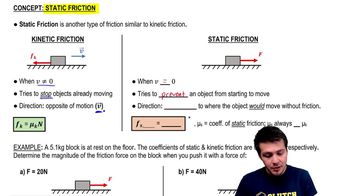
Friction

Friction is the resistive force that opposes the motion of an object sliding over a surface. It depends on the nature of the surfaces in contact and the normal force acting between them. In this case, the frictional force will play a crucial role in determining the magnitude of the applied force needed to maintain constant speed as the box slides down the wall.
Recommended video:
Guided course
08:11
Static Friction & Equilibrium

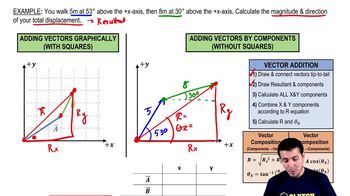
Components of Force

When a force is applied at an angle, it can be resolved into horizontal and vertical components using trigonometric functions. For the 45° angle in this problem, both the horizontal and vertical components of the applied force will affect the box's motion. Understanding how to calculate these components is essential for determining the correct magnitude of the force needed to achieve constant speed.
Recommended video:
Guided course
07:30
Vector Addition By Components
Related Practice
Textbook Question

Astronauts in space 'weigh' themselves by oscillating on a spring. Suppose the position of an oscillating 75 kg astronaut is given by x=(0.30m)sin((πrad/s)×t)x = (0.30 \, \(\text{m}\)) \(\sin\)((\(\pi\) \, \(\text{rad/s}\)) \(\times\) t), where t is in s. What force does the spring exert on the astronaut at (a) t = 1.0 s and (b) 1.5 s? Note that the angle of the sine function is in radians.

2
views
Textbook Question

A 1.0 kg wood block is pressed against a vertical wood wall by the 12 N force shown in FIGURE P6.57. If the block is initially at rest, will it move upward, move downward, or stay at rest?

Textbook Question

A 500 g ball moves horizontally with velocity v𝓍 = ( 15 m) / (t + 1 s) for t > 0 s. What is the net force on the ball at t = 1 s?

Textbook Question

A particle of mass m moving along the x-axis experiences the net force Fₓ = ct, where c is a constant. The particle has velocity v₀ₓ at t = 0. Find an algebraic expression for the particle's velocity vₓ at a later time t.

2
views
Textbook Question

A 5.0 kg wooden sled is launched up a 25° snow-covered slope with an initial speed of 10 m/s. What vertical height does the sled reach above its starting point?

12
views
Textbook Question

A large box of mass M is moving on a horizontal surface at speed v₀. A small box of mass m sits on top of the large box. The coefficients of static and kinetic friction between the two boxes are μs and μk, respectively. Find an expression for the shortest distance dmin in which the large box can stop without the small box slipping.