
Textbook Question
Two identical particles have equal but opposite momenta, and , but they are not traveling along the same line. Show that the total angular momentum of this system does not depend on the choice of origin.

 Verified step by step guidance
 06:18
06:18
 07:07
07:07 12:12
12:12Two identical particles have equal but opposite momenta, and , but they are not traveling along the same line. Show that the total angular momentum of this system does not depend on the choice of origin.
An engineer estimates that under the most adverse expected weather conditions, the total force on the highway sign in Fig. 11–33 will be = (± 2.4 î - 4.1 ĵ) kN, acting at the cm. What torque does this force exert about the base O?
A particle is at the position (x, y, z) = (1.0, 2.0, 3.0)m. It is traveling with a vector velocity (-5.0 ,+ 2.8, -3.1)m/s. Its mass is 4.3 kg. What is its vector angular momentum about the origin?
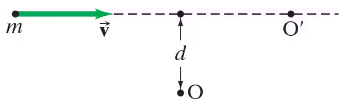
Calculate the angular momentum of a particle of mass m moving with constant velocity υ for two cases (see Fig. 11–34): about origin O.
Show that î x ĵ = k̂ , î x k̂ = - ĵ, and ĵ x k̂ = î.
Two lightweight rods 24 cm in length are mounted perpendicular to an axle and at 180° to each other (Fig. 11–35). At the end of each rod is a 480-g mass. The rods are spaced 42 cm apart along the axle. The axle rotates at 4.5 rad/s.
(a) What is the component of the total angular momentum along the axle?
(b) What angle does the vector angular momentum make with the axle? [Hint: Remember that the vector angular momentum must be calculated about the same point for both masses, which could be the cm.]