Ch 31: Electromagnetic Fields and Waves
Knight Calc - Physics for Scientists and Engineers 5th Edition
Knight Calc5th EditionPhysics for Scientists and EngineersISBN: 9780137344796Not the one you use?Change textbook
Chapter 31, Problem 53

For a science project, you would like to horizontally suspend an 8.5 by 11 inch sheet of black paper in a vertical beam of light whose dimensions exactly match the paper. If the mass of the sheet is 1.0 g, what light intensity will you need?

Verified step by step guidance
1
Understand the problem: The goal is to determine the light intensity required to suspend a sheet of paper horizontally in a vertical beam of light. The force exerted by the light must balance the gravitational force acting on the paper.
Calculate the gravitational force acting on the paper. The gravitational force is given by \( F_g = m \cdot g \), where \( m \) is the mass of the paper (1.0 g = 0.001 kg) and \( g \) is the acceleration due to gravity (\( 9.8 \; \text{m/s}^2 \)).
Relate the force exerted by the light to the radiation pressure. The radiation pressure \( P \) is given by \( P = \frac{I}{c} \) for perfectly absorbing surfaces, where \( I \) is the light intensity and \( c \) is the speed of light (\( 3.0 \times 10^8 \; \text{m/s} \)). The force exerted by the light is \( F_{light} = P \cdot A \), where \( A \) is the area of the paper.
Set the forces equal to each other for equilibrium: \( F_g = F_{light} \). Substituting the expressions, \( m \cdot g = \frac{I}{c} \cdot A \). Solve for \( I \): \( I = \frac{m \cdot g \cdot c}{A} \).
Substitute the known values into the equation. The area \( A \) of the paper is \( 8.5 \; \text{in} \times 11 \; \text{in} \), which must be converted to square meters (1 inch = 0.0254 m). Use \( m = 0.001 \; \text{kg} \), \( g = 9.8 \; \text{m/s}^2 \), and \( c = 3.0 \times 10^8 \; \text{m/s} \) to calculate \( I \).

Verified video answer for a similar problem:

This video solution was recommended by our tutors as helpful for the problem above.
Was this helpful?

Key Concepts

Here are the essential concepts you must grasp in order to answer the question correctly.

Light Intensity

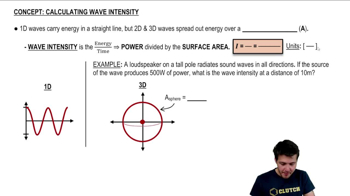
Light intensity refers to the power per unit area carried by a beam of light. It is typically measured in watts per square meter (W/m²). In this context, the intensity of the light beam must be sufficient to exert an upward force on the paper that counteracts its weight, allowing it to be suspended in the beam.
Recommended video:
Guided course
02:32
Wave Intensity

Weight and Force

Weight is the force exerted by gravity on an object, calculated as the product of its mass and the acceleration due to gravity (approximately 9.81 m/s² on Earth). For the paper in this scenario, its weight must be balanced by the upward force generated by the light intensity to achieve suspension.
Recommended video:
Guided course
10:19
Torque Due to Weight

Radiation Pressure

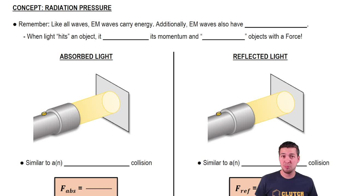
Radiation pressure is the pressure exerted by electromagnetic radiation on a surface. When light strikes an object, it transfers momentum, creating a force. The amount of force generated depends on the intensity of the light and the area it covers, which is crucial for determining how much light intensity is needed to suspend the paper.
Recommended video:
Guided course
07:51
Radiation Pressure
Related Practice
Textbook Question

A laser beam shines straight up onto a flat, black foil of mass m. Find an expression for the laser power P needed to levitate the foil.

2
views

Textbook Question

When the Voyager 2 spacecraft passed Neptune in 1989, it was 4.5×10⁹ km from the earth. Its radio transmitter, with which it sent back data and s, broadcast with a mere 21 W of power. Assuming that the transmitter broadcast equally in all directions, What signal intensity was received on the earth?

2
views
Textbook Question

The intensity of sunlight reaching the earth is 1360 W/m2. Assuming all the sunlight is absorbed, what is the radiation-pressure force on the earth? Give your answer in newtons.

1
views
Textbook Question

Unpolarized light of intensity I₀ is incident on a stack of 7 polarizing filters, each with its axis rotated 15° cw with respect to the previous filter. What light intensity emerges from the last filter?

13
views
Textbook Question

Consider current I passing through a resistor of radius r, length L, and resistance R. Determine the electric and magnetic fields at the surface of the resistor. Assume that the electric field is uniform throughout, including at the surface.

Textbook Question

It has been proposed that small spacecraft could reach other planets in a fairly short time—days instead of many months—if they unfurl a reflective sail and are accelerated by a powerful laser beam generated by an earth-orbiting laser. What speed would a spacecraft need to reach Mars in 8.0 days when Mars is closest to earth?