Ch 31: Electromagnetic Fields and Waves
Knight Calc - Physics for Scientists and Engineers 5th Edition
Knight Calc5th EditionPhysics for Scientists and EngineersISBN: 9780137344796Not the one you use?Change textbook
Chapter 31, Problem 58

Unpolarized light of intensity I₀ is incident on a stack of 7 polarizing filters, each with its axis rotated 15° cw with respect to the previous filter. What light intensity emerges from the last filter?

Verified step by step guidance
1
Start by recalling Malus's Law, which states that the intensity of light passing through a polarizing filter is given by: I = I_0 \(\cos\)^2(\(\theta\)), where \(\theta\) is the angle between the light's polarization direction and the filter's axis.
Since the light is unpolarized initially, the intensity after the first polarizer is halved. Thus, the intensity after the first filter is: I_1 = \(\frac{I_0}{2}\).
For each subsequent filter, the light's intensity is reduced according to Malus's Law. The angle between the polarization direction of the light and the axis of each filter increases by 15° for each filter. For the second filter, the intensity is: I_2 = I_1 \(\cos\)^2(15^\(\circ\)). Similarly, for the third filter: I_3 = I_2 \(\cos\)^2(15^\(\circ\)), and so on.
Generalize the process for the stack of 7 filters. The intensity after the nth filter can be expressed as: I_n = I_{n-1} \(\cos\)^2(15^\(\circ\)). By substituting iteratively, the final intensity after the 7th filter is: I_7 = \(\frac{I_0}{2}\) \(\cdot\) \(\cos\)^2(15^\(\circ\)) \(\cdot\) \(\cos\)^2(15^\(\circ\)) \(\cdot\) \(\cos\)^2(15^\(\circ\)) \(\cdot\) \(\cos\)^2(15^\(\circ\)) \(\cdot\) \(\cos\)^2(15^\(\circ\)) \(\cdot\) \(\cos\)^2(15^\(\circ\)).
Simplify the expression for the final intensity: I_7 = \(\frac{I_0}{2}\) \(\cdot\) (\(\cos\)^2(15^\(\circ\)))^6. This is the intensity of light that emerges from the last filter.

Verified video answer for a similar problem:

This video solution was recommended by our tutors as helpful for the problem above.
Was this helpful?

Key Concepts

Here are the essential concepts you must grasp in order to answer the question correctly.

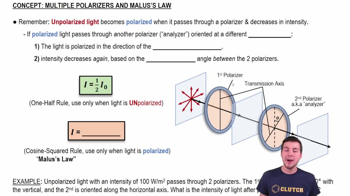
Malus's Law

Malus's Law states that when polarized light passes through a polarizing filter, the intensity of the transmitted light (I) is given by I = I₀ * cos²(θ), where I₀ is the intensity of the incident light and θ is the angle between the light's polarization direction and the filter's axis. This principle is fundamental in understanding how light intensity changes as it passes through multiple polarizers.
Recommended video:
Guided course
09:47
Multiple Polarizers & Malus's Law

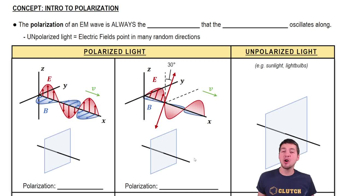
Polarization of Light

Polarization refers to the orientation of the oscillations of light waves. Unpolarized light consists of waves vibrating in multiple planes, while polarized light has waves that oscillate in a single plane. When unpolarized light passes through a polarizer, it becomes polarized, and its intensity is reduced according to the angle of the polarizer relative to the light's initial polarization direction.
Recommended video:
Guided course
05:32
Introduction to Polarization

Cumulative Effect of Multiple Polarizers

When unpolarized light passes through multiple polarizing filters, each filter reduces the intensity of the light based on its angle relative to the previous filter. The cumulative effect can be calculated by applying Malus's Law sequentially for each filter. In this case, with 7 filters each rotated by 15°, the intensity after each filter must be calculated iteratively to find the final intensity after the last filter.
Recommended video:
Guided course
09:47
Multiple Polarizers & Malus's Law