

Ch 29: Electromagnetic Induction
Young & Freedman Calc - University Physics 14th Edition
Young & Freedman Calc14th EditionUniversity PhysicsISBN: 9780321973610Not the one you use?Change textbook
Chapter 29, Problem 41

A long, straight solenoid with a cross-sectional area of 8.00 cm2 is wound with 90 turns of wire per centimeter, and the windings carry a current of 0.350 A. A second winding of 12 turns encircles the solenoid at its center. The current in the solenoid is turned off such that the magnetic field of the solenoid becomes zero in 0.0400 s. What is the average induced emf in the second winding?

Verified step by step guidance
1
First, understand that the solenoid creates a magnetic field when current flows through it. The magnetic field inside a long solenoid is given by the formula: B=μnI, where μ is the permeability of free space, n is the number of turns per unit length, and I is the current.
Calculate the initial magnetic field inside the solenoid using the given values: n=90/1cm (convert to meters), I=0.350A, and μ=4π×107Tm/A.
Determine the change in magnetic flux through the second winding. The magnetic flux Φ is given by Φ=BA, where A is the cross-sectional area of the solenoid. Initially, Φ is non-zero, and finally, it becomes zero when the current is turned off.
Use Faraday's law of electromagnetic induction to find the average induced emf in the second winding. Faraday's law states that the induced emf ε is equal to the negative rate of change of magnetic flux: ε=-ΔΦΔt. Calculate ΔΦ and divide by the time interval Δt=0.0400s.
Finally, multiply the induced emf by the number of turns in the second winding to find the total average induced emf. The second winding has 12 turns, so the total induced emf is ε×12.

Verified video answer for a similar problem:

This video solution was recommended by our tutors as helpful for the problem above.
Video duration:
7m
Was this helpful?

Key Concepts

Here are the essential concepts you must grasp in order to answer the question correctly.

Faraday's Law of Electromagnetic Induction

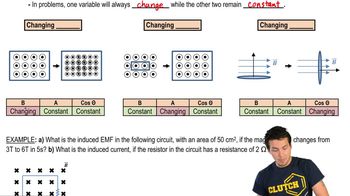
Faraday's Law states that a change in magnetic flux through a circuit induces an electromotive force (emf) in the circuit. The induced emf is proportional to the rate of change of the magnetic flux. In this problem, the solenoid's magnetic field changes, inducing an emf in the second winding.
Recommended video:
Guided course
09:26
Faraday's Law

Magnetic Flux

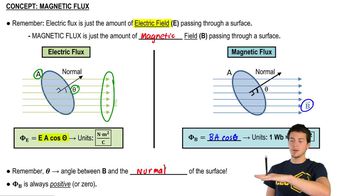
Magnetic flux is the product of the magnetic field and the area it penetrates, perpendicular to the field lines. It is a measure of the quantity of magnetism, considering the strength and extent of a magnetic field. The change in magnetic flux through the second winding is crucial for calculating the induced emf.
Recommended video:
Guided course
04:52
Magnetic Flux

Solenoid Magnetic Field

A solenoid generates a uniform magnetic field inside its coils when a current passes through it. The field strength is determined by the number of turns per unit length and the current. Understanding how the solenoid's field changes when the current is turned off helps in determining the change in magnetic flux and the resulting induced emf.
Recommended video:
Guided course
13:54
Magnetic Field Produced by Loops and Solenoids
Related Practice
Textbook Question

The magnetic field B at all points within the colored circle shown in Fig. E29.15 has an initial magnitude of 0.750 T. (The circle could represent approximately the space inside a long, thin solenoid.) The magnetic field is directed into the plane of the diagram and is decreasing at the rate of -0.0350 T/s. What is the emf between points a and b on the ring?

<Image>

1
views
Textbook Question

The magnetic field B at all points within the colored circle shown in Fig. E29.15 has an initial magnitude of 0.750 T. (The circle could represent approximately the space inside a long, thin solenoid.) The magnetic field is directed into the plane of the diagram and is decreasing at the rate of -0.0350 T/s. What is the current in the ring if its resistance is 4.00 Ω?

<Image>

4
views
Textbook Question

A parallel-plate, air-filled capacitor is being charged as in Fig. 29.23. The circular plates have radius 4.00 cm, and at a particular instant the conduction current in the wires is 0.520 A. What is the rate at which the electric field between the plates is changing?

1
views
Textbook Question

A parallel-plate, air-filled capacitor is being charged as in Fig. 29.23. The circular plates have radius 4.00 cm, and at a particular instant the conduction current in the wires is 0.520 A. (a) What is the displacement current density jD in the air space between the plates?

1
views
Textbook Question

A parallel-plate, air-filled capacitor is being charged as in Fig. 29.23. The circular plates have radius 4.00 cm, and at a particular instant the conduction current in the wires is 0.520 A. (c) What is the induced magnetic field between the plates at a distance of 2.00 cm from the axis? (d) At 1.00 cm from the axis?

2
views
Textbook Question

The magnetic field B at all points within the colored circle shown in Fig. E29.15 has an initial magnitude of 0.750 T. (The circle could represent approximately the space inside a long, thin solenoid.) The magnetic field is directed into the plane of the diagram and is decreasing at the rate of -0.0350 T/s. If the ring is cut at some point and the ends are separated slightly, what will be the emf between the ends?

<Image>

1
views