Ch 29: Electromagnetic Induction
Young & Freedman Calc - University Physics 14th Edition
Young & Freedman Calc14th EditionUniversity PhysicsISBN: 9780321973610Not the one you use?Change textbook
Chapter 29, Problem 40c

The magnetic field B at all points within the colored circle shown in Fig. E29.15 has an initial magnitude of 0.750 T. (The circle could represent approximately the space inside a long, thin solenoid.) The magnetic field is directed into the plane of the diagram and is decreasing at the rate of -0.0350 T/s. What is the current in the ring if its resistance is 4.00 Ω?
<Image>

Verified step by step guidance
1
Identify that the problem involves electromagnetic induction, specifically Faraday's law of induction, which relates the induced electromotive force (emf) in a loop to the rate of change of magnetic flux through the loop.
Use Faraday's law of induction, which states that the induced emf (ε) is equal to the negative rate of change of magnetic flux (Φ) through the loop: ε = -dΦ/dt.
Recognize that the magnetic flux (Φ) through the loop is given by the product of the magnetic field (B) and the area (A) of the loop: Φ = B * A. Since the magnetic field is uniform and perpendicular to the plane of the loop, this simplifies the calculation.
Calculate the rate of change of magnetic flux. Given that the magnetic field is decreasing at a rate of -0.0350 T/s, the rate of change of flux is dΦ/dt = A * dB/dt, where A is the area of the circle.
Apply Ohm's law to find the current (I) in the ring. Ohm's law states that I = ε/R, where R is the resistance of the ring. Substitute the expression for the induced emf from Faraday's law to find the current: I = (-A * dB/dt) / R.

Verified video answer for a similar problem:

This video solution was recommended by our tutors as helpful for the problem above.
Video duration:
5m
Was this helpful?

Key Concepts

Here are the essential concepts you must grasp in order to answer the question correctly.

Faraday's Law of Electromagnetic Induction

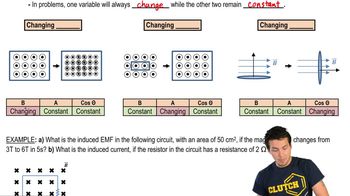
Faraday's Law states that a change in magnetic flux through a circuit induces an electromotive force (EMF) in the circuit. The induced EMF is proportional to the rate of change of the magnetic flux. In this problem, the decreasing magnetic field within the solenoid induces an EMF in the ring, which can be calculated using the rate of change of the magnetic field.
Recommended video:
Guided course
09:26
Faraday's Law

Ohm's Law

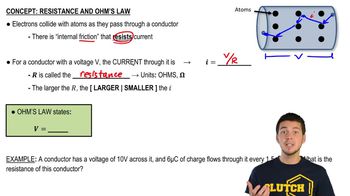
Ohm's Law relates the current flowing through a conductor to the voltage across it and its resistance, expressed as I = V/R. In this context, the induced EMF acts as the voltage across the ring, and the resistance of the ring is given. By applying Ohm's Law, we can determine the current flowing through the ring due to the induced EMF.
Recommended video:
Guided course
03:07
Resistance and Ohm's Law

Magnetic Flux

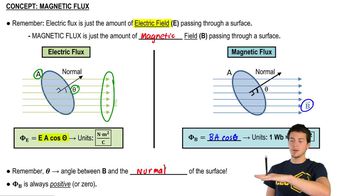
Magnetic flux is a measure of the quantity of magnetism, taking into account the strength and extent of a magnetic field. It is calculated as the product of the magnetic field strength, the area it penetrates, and the cosine of the angle between the field and the normal to the surface. In this problem, the magnetic flux through the ring changes as the magnetic field decreases, leading to the induction of an EMF.
Recommended video:
Guided course
04:52
Magnetic Flux
Related Practice
Textbook Question

The magnetic field B at all points within the colored circle shown in Fig. E29.15 has an initial magnitude of 0.750 T. (The circle could represent approximately the space inside a long, thin solenoid.) The magnetic field is directed into the plane of the diagram and is decreasing at the rate of -0.0350 T/s. What is the emf between points a and b on the ring?

<Image>

1
views
Textbook Question

A long, straight solenoid with a cross-sectional area of 8.00 cm2 is wound with 90 turns of wire per centimeter, and the windings carry a current of 0.350 A. A second winding of 12 turns encircles the solenoid at its center. The current in the solenoid is turned off such that the magnetic field of the solenoid becomes zero in 0.0400 s. What is the average induced emf in the second winding?

Textbook Question

A long, thin solenoid has 400 turns per meter and radius 1.10 cm. The current in the solenoid is increasing at a uniform rate di/dt. The induced electric field at a point near the center of the solenoid and 3.50 cm from its axis is 8.00 × 10⁻⁶ V/m. Calculate di/dt.

Textbook Question

A long, thin solenoid has 900 turns per meter and radius 2.50 cm. The current in the solenoid is increasing at a uniform rate of 36.0 A/s. What is the magnitude of the induced electric field at a point near the center of the solenoid and (a) 0.500 cm from the axis of the solenoid; (b) 1.00 cm from the axis of the solenoid?

1
views
Textbook Question

The magnetic field B at all points within the colored circle shown in Fig. E29.15 has an initial magnitude of 0.750 T. (The circle could represent approximately the space inside a long, thin solenoid.) The magnetic field is directed into the plane of the diagram and is decreasing at the rate of -0.0350 T/s. If the ring is cut at some point and the ends are separated slightly, what will be the emf between the ends?

<Image>

1
views
Textbook Question

The magnetic field B at all points within the colored circle shown in Fig. E29.15 has an initial magnitude of 0.750 T. (The circle could represent approximately the space inside a long, thin solenoid.) The magnetic field is directed into the plane of the diagram and is decreasing at the rate of -0.0350 T/s. What is the shape of the field lines of the induced electric field shown in Fig. E29.15 , within the colored circle?

<Image>

1
views