
Ch 28: Fundamentals of Circuits
Knight Calc - Physics for Scientists and Engineers 5th Edition
Knight Calc5th EditionPhysics for Scientists and EngineersISBN: 9780137344796Not the one you use?Change textbook
Chapter 28, Problem 72

A 15 μF capacitor charged to 12 V is discharged through a resistor. The energy stored in the capacitor decreases by 50% in 0.25 s. What is the value of the resistance?

Verified step by step guidance
1
Step 1: Start by recalling the formula for the energy stored in a capacitor: \( E = \frac{1}{2} C V^2 \), where \( C \) is the capacitance and \( V \) is the voltage across the capacitor. This will help us understand how the energy changes over time.
Step 2: Use the fact that the energy decreases by 50% in 0.25 seconds. The energy at any time \( t \) during discharge is given by \( E(t) = E_0 e^{-\frac{t}{RC}} \), where \( E_0 \) is the initial energy, \( R \) is the resistance, and \( C \) is the capacitance. Substitute \( E(t) = 0.5 E_0 \) and \( t = 0.25 \) s into this equation.
Step 3: Simplify the equation \( 0.5 E_0 = E_0 e^{-\frac{0.25}{RC}} \). Cancel \( E_0 \) on both sides to get \( 0.5 = e^{-\frac{0.25}{RC}} \). Take the natural logarithm of both sides to isolate \( \frac{0.25}{RC} \): \( \ln(0.5) = -\frac{0.25}{RC} \).
Step 4: Rearrange the equation \( \ln(0.5) = -\frac{0.25}{RC} \) to solve for \( R \): \( R = -\frac{0.25}{C \ln(0.5)} \). Substitute \( C = 15 \mu F = 15 \times 10^{-6} \) F into the equation.
Step 5: Perform the substitution and simplify the expression for \( R \). Ensure the units are consistent throughout the calculation. The resistance \( R \) can now be calculated using the given values.

Verified video answer for a similar problem:

This video solution was recommended by our tutors as helpful for the problem above.
Video duration:
8m
Was this helpful?

Key Concepts

Here are the essential concepts you must grasp in order to answer the question correctly.

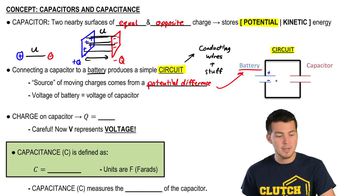
Capacitance

Capacitance is the ability of a capacitor to store electrical energy in an electric field, measured in farads (F). It is defined as the charge stored per unit voltage across the capacitor. In this case, the 15 μF capacitor can store energy based on its capacitance and the voltage applied, which is crucial for understanding how much energy is initially stored.
Recommended video:
Guided course
08:02
Capacitors & Capacitance (Intro)

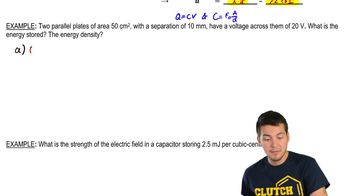
Energy Stored in a Capacitor

The energy (E) stored in a capacitor can be calculated using the formula E = 1/2 CV², where C is the capacitance and V is the voltage. This relationship is essential for determining how much energy is present in the capacitor before and after discharge. In this scenario, knowing that the energy decreases by 50% allows us to calculate the initial and final energy values.
Recommended video:
Guided course
09:26
Energy Stored by Capacitor

RC Time Constant

The RC time constant (τ) is a measure of the time it takes for the voltage across a capacitor to charge or discharge through a resistor. It is calculated as τ = R × C, where R is the resistance and C is the capacitance. This concept is vital for understanding the rate of energy loss in the circuit, particularly since the problem states that the energy decreases by 50% in a specific time frame.
Recommended video:
Guided course
08:59
Phase Constant of a Wave Function
Related Practice
Textbook Question

The capacitor in an RC circuit is discharged with a time constant of 10 ms. At what time after the discharge begins are (a) the charge on the capacitor reduced to half its initial value and (b) the energy stored in the capacitor reduced to half its initial value?

1
views
Textbook Question

You’ve made the finals of the Science Olympics! As one of your tasks, you’re given 1.0 g of aluminum and asked to make a wire, using all the aluminum, that will dissipate 7.5 W when connected to a 1.5 V battery. What length and diameter will you choose for your wire?

2
views
Textbook Question

The capacitor in FIGURE P28.73 begins to charge after the switch closes at t = 0 s. Find an expression for the current I at time t. Graph I from t = 0 to t = 5τ.

1
views
Textbook Question

The flash on a compact camera stores energy in a 120 μF capacitor that is charged to 220 V. When the flash is fired, the capacitor is quickly discharged through a lightbulb with 5.0 Ω of resistance. At what rate is the lightbulb dissipating energy 250 μs after the flash is fired?

1
views
Textbook Question

A 150 μF defibrillator capacitor is charged to 1500 V. When fired through a patient’s chest, it loses 95% of its charge in 40 ms. What is the resistance of the patient’s chest?

1
views
Textbook Question

A circuit you’re using discharges a 20 μF capacitor through an unknown resistor. After charging the capacitor, you close a switch at t = 0 s and then monitor the resistor current with an ammeter. Your data are as follows: Use an appropriate graph of the data to determine (a) the resistance and (b) the initial capacitor voltage.

1
views