Ch. 13 - Fluids
Giancoli Douglas - Physics for Scientists and Engineers 5th edition
Giancoli Douglas5th editionPhysics for Scientists and EngineersISBN: 9780137488179Not the one you use?Change textbook
Chapter 13, Problem 80b

A 3.2-N force is applied to the plunger of a hypodermic needle. If the diameter of the plunger is 1.3 cm and that of the needle is 0.20 mm, what force on the plunger would be needed to push fluid into a vein where the gauge pressure is 75 mm-Hg? Answer for the instant just before the fluid starts to move.

Verified step by step guidance
1
Step 1: Understand the problem. The problem involves fluid mechanics and Pascal's principle, which states that pressure applied to a confined fluid is transmitted undiminished throughout the fluid. We are tasked with finding the force required on the plunger to overcome the gauge pressure in the vein.
Step 2: Convert the given quantities into consistent SI units. The gauge pressure is given as 75 mm-Hg. Convert this to Pascals (Pa) using the relation: \( 1 \text{ mm-Hg} = 133.322 \text{ Pa} \). Thus, \( P_{gauge} = 75 \times 133.322 \text{ Pa} \).
Step 3: Calculate the cross-sectional areas of the plunger and the needle. The diameter of the plunger is 1.3 cm, so its radius is \( r_{plunger} = \frac{1.3}{2} \text{ cm} = 0.0065 \text{ m} \). The area is given by \( A_{plunger} = \pi r_{plunger}^2 \). Similarly, the diameter of the needle is 0.20 mm, so its radius is \( r_{needle} = \frac{0.20}{2} \text{ mm} = 0.0001 \text{ m} \), and \( A_{needle} = \pi r_{needle}^2 \).
Step 4: Use Pascal's principle to relate the forces and pressures. The pressure exerted by the plunger is \( P_{plunger} = \frac{F_{plunger}}{A_{plunger}} \), and the pressure at the needle is \( P_{needle} = \frac{F_{needle}}{A_{needle}} \). Since the fluid is incompressible, \( P_{plunger} = P_{needle} \).
Step 5: Solve for the required force on the plunger. The pressure at the needle must overcome the gauge pressure in the vein, so \( P_{needle} = P_{gauge} \). Substitute \( P_{needle} = \frac{F_{needle}}{A_{needle}} \) and \( P_{plunger} = \frac{F_{plunger}}{A_{plunger}} \) into the equality \( P_{plunger} = P_{needle} \), and solve for \( F_{plunger} \): \( F_{plunger} = P_{gauge} \times A_{plunger} \).

Verified video answer for a similar problem:

This video solution was recommended by our tutors as helpful for the problem above.
Video duration:
3m
Was this helpful?

Key Concepts

Here are the essential concepts you must grasp in order to answer the question correctly.

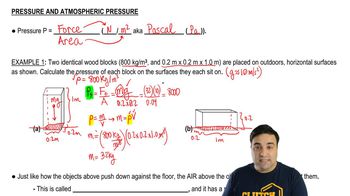
Pressure

Pressure is defined as the force applied per unit area. In this context, it is crucial to understand how the pressure exerted by the fluid in the needle relates to the force applied on the plunger. The gauge pressure of 75 mm-Hg indicates the pressure above atmospheric pressure that must be overcome to initiate fluid flow.
Recommended video:
Guided course
17:04
Pressure and Atmospheric Pressure

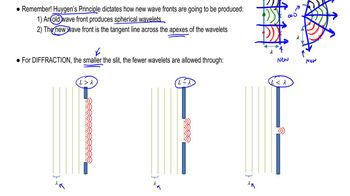
Pascal's Principle

Pascal's Principle states that a change in pressure applied to an enclosed fluid is transmitted undiminished throughout the fluid. This principle is essential for understanding how the force applied to the plunger translates to pressure in the needle, allowing us to calculate the necessary force to overcome the gauge pressure in the vein.
Recommended video:
Guided course
14:47
Diffraction with Huygen's Principle

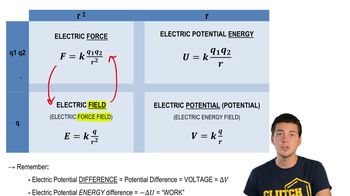
Area and Force Relationship

The relationship between area and force is fundamental in fluid mechanics. The force exerted by the plunger can be calculated using the formula F = P × A, where P is the pressure and A is the cross-sectional area. Understanding how to calculate the area of the plunger and the needle is vital for determining the force required to push the fluid into the vein.
Recommended video:
Guided course
03:43
Relationships Between Force, Field, Energy, Potential
Related Practice
Textbook Question

Estimate the diameter of a steel needle that can just barely remain on top of water due to surface tension. (See Figs. 13–38 and 13–39a, and Table 13–1.)

3
views

Textbook Question

A common effect of surface tension is the ability of a liquid to rise up a narrow tube due to capillary action. Show that for a narrow tube of radius r placed in a liquid of density ρ and surface tension γ, the liquid in the tube will reach a height h = 2γ/ρgr above the level of the liquid outside the tube, where g is the gravitational acceleration. Assume that the liquid “wets” the tube and that the liquid surface is vertical at the contact with the inside of the tube.

1
views
Textbook Question

A 3.2-N force is applied to the plunger of a hypodermic needle. If the diameter of the plunger is 1.3 cm and that of the needle is 0.20 mm, with what force does the fluid leave the needle?

Textbook Question

A hydraulic lift is used to jack a 960-kg car 52 cm off the floor. The diameter of the output piston is 18 cm, and the input force is 380 N. What is the area of the input piston?

1
views
Textbook Question

When you ascend or descend a great deal when driving in a car, your ears “pop,” which means that the pressure behind the eardrum is being equalized to that outside. If this did not happen, what would be the approximate force on an eardrum of area 0.20cm² if a change in altitude of 1120 m takes place?

1
views
Textbook Question

A pump supplies water to a 1.59-cm inner diameter hose that tapers down to a 0.953-cm-diameter nozzle. The nozzle is aimed so water comes out at a 45° angle and lands 3.0 m away. The nozzle is 0.60 m above ground level, and the pump output is essentially at ground level. What pressure is supplied by the pump?

2
views