
A common effect of surface tension is the ability of a liquid to rise up a narrow tube due to capillary action. Show that for a narrow tube of radius r placed in a liquid of density ρ and surface tension γ, the liquid in the tube will reach a height h = 2γ/ρgr above the level of the liquid outside the tube, where g is the gravitational acceleration. Assume that the liquid “wets” the tube and that the liquid surface is vertical at the contact with the inside of the tube.
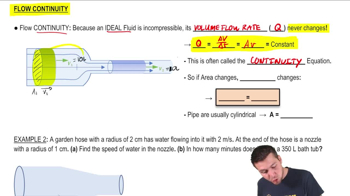
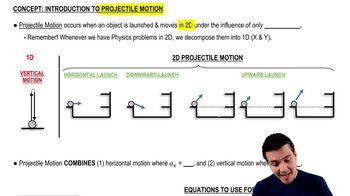
A pump supplies water to a 1.59-cm inner diameter hose that tapers down to a 0.953-cm-diameter nozzle. The nozzle is aimed so water comes out at a 45° angle and lands 3.0 m away. The nozzle is 0.60 m above ground level, and the pump output is essentially at ground level. What pressure is supplied by the pump?
Verified step by step guidance
Verified video answer for a similar problem:
Key Concepts
Bernoulli's Principle
Continuity Equation
Projectile Motion
A 3.2-N force is applied to the plunger of a hypodermic needle. If the diameter of the plunger is 1.3 cm and that of the needle is 0.20 mm, what force on the plunger would be needed to push fluid into a vein where the gauge pressure is 75 mm-Hg? Answer for the instant just before the fluid starts to move.
A 3.2-N force is applied to the plunger of a hypodermic needle. If the diameter of the plunger is 1.3 cm and that of the needle is 0.20 mm, with what force does the fluid leave the needle?
A hydraulic lift is used to jack a 960-kg car 52 cm off the floor. The diameter of the output piston is 18 cm, and the input force is 380 N. What is the area of the input piston?
When you ascend or descend a great deal when driving in a car, your ears “pop,” which means that the pressure behind the eardrum is being equalized to that outside. If this did not happen, what would be the approximate force on an eardrum of area 0.20cm² if a change in altitude of 1120 m takes place?
When a person drives or hikes to a higher altitude, and even more during descent, volume changes of trapped air in the middle ear can cause ear discomfort until the middle-ear pressure and exterior pressure are equalized. If a rapid descent at a rate of 7.0 m/s or faster commonly causes ear discomfort, what is the maximum rate of increase in atmospheric pressure (that is, dP/dt) tolerable to most people?
