
Ch 13: Newton's Theory of Gravity
Knight Calc - Physics for Scientists and Engineers 5th Edition
Knight Calc5th EditionPhysics for Scientists and EngineersISBN: 9780137344796Not the one you use?Change textbook
Chapter 13, Problem 19

Two stars, one twice as massive as the other, are 1.0 light year (ly) apart. One light year is the distance light travels in one year at the speed of light, 3.00 ✕ 108 m/s . The gravitational potential energy of this double-star system is - 8.0 ✕ 1034 J. What is the mass of the lighter star?

Verified step by step guidance
1
Step 1: Recall the formula for gravitational potential energy between two masses: U = -(Gm1m2)r, where U is the gravitational potential energy, G is the gravitational constant (6.674 × 10⁻¹¹ m3kg-1s-2), m1 and m2 are the masses of the two stars, and r is the distance between them.
Step 2: Let the mass of the lighter star be m. Since the other star is twice as massive, its mass is 2m. Substitute these into the formula for gravitational potential energy: U = -(Gm2m)r.
Step 3: Simplify the expression for gravitational potential energy: U = -(2Gm2)r. Substitute the given values: U = -8.0 × 1034 J, r = 1.0 ly (convert to meters: 1.0 ly = 9.461 × 10¹⁵ m), and G = 6.674 × 10⁻¹¹.
Step 4: Rearrange the formula to solve for m: m2 = -Ur2G. Take the square root to find m: m = (-Ur)2G.
Step 5: Substitute the known values into the rearranged formula to calculate m. Ensure all units are consistent (e.g., meters, kilograms, seconds) before performing the calculation.

Verified video answer for a similar problem:

This video solution was recommended by our tutors as helpful for the problem above.
Video duration:
6m
Was this helpful?

Key Concepts

Here are the essential concepts you must grasp in order to answer the question correctly.

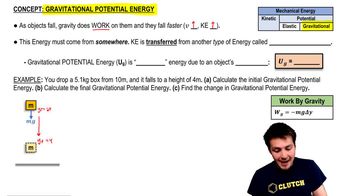
Gravitational Potential Energy

Gravitational potential energy (U) in a two-body system is the energy associated with the gravitational interaction between the two masses. It is given by the formula U = -G(m1*m2)/r, where G is the gravitational constant, m1 and m2 are the masses of the two objects, and r is the distance between their centers. A negative value indicates that the gravitational force is attractive, and the energy decreases as the objects come closer.
Recommended video:
Guided course
06:35
Gravitational Potential Energy

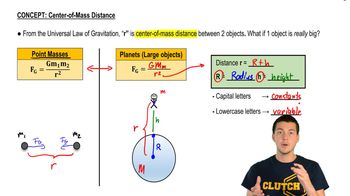
Mass and Distance Relationship

In gravitational interactions, the force and potential energy depend on the masses of the objects and the distance between them. For two stars, if one star is twice as massive as the other, the gravitational potential energy will reflect this ratio. Understanding how mass influences gravitational potential energy is crucial for solving problems involving multiple bodies in space.
Recommended video:
Guided course
07:45
Center of Mass Distance

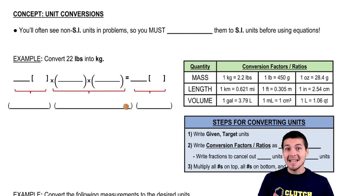
Units of Measurement in Astronomy

In astronomy, distances are often measured in light years (ly), which is the distance light travels in one year, approximately 9.46 trillion kilometers. This unit is essential for understanding the vast distances between celestial objects. Additionally, energy is measured in joules (J), and recognizing the conversion between these units is important for calculations involving gravitational potential energy in astrophysical contexts.
Recommended video:
Guided course
07:46
Unit Conversions